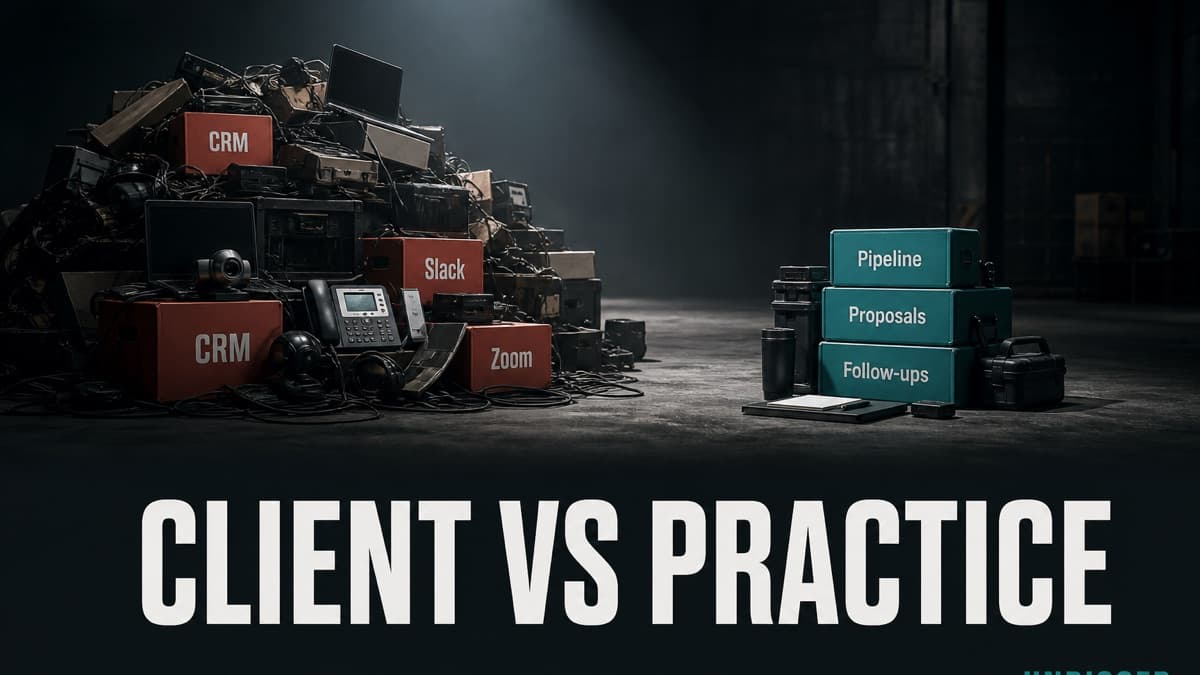
Storing contacts is not the same as knowing who this week is for. CRMs, EOS Traction, Outgrow, and AI chatbots were built for teams with pipelines and weekly huddles. A practice of one needs four piles (Prospects, Clients, Referral Partners, Other) and one weekly decision: who is next, and why them.
For a long time I thought I needed a better place to put my contacts.
I have Prospects. I have Clients. I have Referral Partners. And I have a fourth pile I still call Other: LinkedIn connections I never classified, people from a conference I never sorted, someone a colleague mentioned and I filed nowhere. Not one kind of person. A pile.
I tried Pipedrive, HubSpot, and a few other CRMs. I was trying to help my clients, and my clients' clients.
Let me explain what I ran into. Keep reading. I promise I will come to a point that matters for your practice.
EOS assumes chairs that are not there
EOS Traction is a method. It is an operating system for a company with a leadership team. If you have never heard of EOS, you will. EOS Worldwide reports more than 310,000 companies run on the Entrepreneurial Operating System, mostly founder-led businesses with a leadership team, the kind of company most of you are trying to serve.
Some of you use it. Some of you install it for clients. The weekly heartbeat is the Level 10 meeting, the L10: a room of people, same agenda, issues on the table. A solo cannot have an L10 meeting. There is nobody in the other chairs.
Outgrow is another methodology you see running through EOS companies and the implementers who serve them. Josh Goldfayn built it as a sales operating system. Same shape as Traction: a method, certified advisors, a weekly rhythm you run as a team. A practice of one does not have that team. You cannot huddle with an empty chair any more than you can run an L10 by yourself.
Let me be honest. Most of us hate outbound sales. Cold calling, quota pressure, chasing strangers who do not know your work: I get it. For a solopreneur it is not the most effective use of your week anyway. You need to know who is next, and why. You do not need a quota because a manager is watching.
Referral Partners beat a full week of posting
I have built more than one company. Chief Outsiders was one of them. I am not guessing about what compounds for a practice of one.
Referral Partners are the best use of time when you are choosing who to talk to this week: identifying them, nurturing them, adding more. LinkedIn still matters. Writing there moves some cold people to warm over time. Henning Schwinum is clear in Right-Sized, Right-Skilled that most fractional matches still come through relationships, referrals, and networking, not job boards or gig platforms.
The warmest usually trace back to people who already knew your work. A full week of posting still does not tell you who is next on Tuesday.
The mistake I keep seeing is the same one as the software. There is no map. Yogi Berra said it plain: if you do not know where you are going, you might wind up someplace else.
The homework trap
I know many of you have hired experts: LinkedIn coaches, business development advisors, AI sales tools. They hand you homework: post three times a week, send this sequence, try this prompt. You finish it and still do not know who this week is for.
Traction and Outgrow are methods. HubSpot and Pipedrive are products. All of them assume a team running inside a company, not one person running a practice.
ChatGPT, or whatever AI you favor, does not have the MAP. It does not know who to call today, or why. It will not fix your positioning either. Hall and Oates had it on Out of Touch in eighty-four: out of touch is a contact list with nobody to call on Tuesday.
HubSpot started as a small-business platform. I built Chief Outsiders on it. By the time I tried it again out of loyalty, the product had moved upstream: annual commits, more hubs, more seats. Pipedrive is simpler. It is a pipeline of deals. It will store the name and the stage. You still decide who is next.
What none of them answered, for me: given Prospects, Clients, Referral Partners, and Other, who do I talk to this week, and why.

A bigger driver is not the same as knowing where the pin is. Callaway launched the Big Bertha over thirty years ago. The club was amazing. For all of that, the average golfer still shoots in the mid-90s. Traction, Outgrow, Pipedrive, HubSpot, and your favorite AI are the same class of problem. They will store the contact. They will not tell you who to talk to this week, or why.
Ten minutes on paper
Write four headings: Prospects, Clients, Referral Partners, and Other. Put real names under the first three. Be honest about Other.
A Referral Partner is not someone you met on LinkedIn and exchanged a few nice comments with. It is someone who already knows your work, and who sits in rooms you do not. If they could not introduce you because they cannot say who you help, they are Other. Move them.
When you do not know who is next, start with people who already know your work. The research on dormant ties says reconnecting with someone who already knows your competence can be as useful as staying only with the people you talk to now. Members in The ReTern are finding success with business school acquaintances they had not spoken to in decades, and with former colleagues.
If you are just starting out, do not reach out with the desperate ask that you are looking for work. I have written about this before. The employee mindset shows up in the first sentence, and peers can smell it. When you reach out, listen for how you can help them first. Then, if it fits, give them one positioning sentence: strong enough to remember, important enough that they could refer you when a CEO asks for help.
If you only have time for one heading this week, start with Referral Partners. Pick one person. Why them this week is one of three things: you have something useful to send them, you owe them a reply, or they asked you for something. If none of those are true, pick someone else.
When you can name why them, send what you already owe: an introduction, a note on something they told you, a person they should know. Not circling back. Not checking in.
What I built instead
When I first tried the four piles, I used a sheet of paper on the kitchen table. You do not need software to learn whether the sort is honest.
What I built at The ReTern is membership first: operators running a practice of one together, refusing to depend on luck. The Helm™ is what helps that membership run the week: who is next, and why. Not another place to store contacts. Not a sales-team grind. The community is the point. The software sharpens the practice.
Freedom, for me, is a pipeline I control. That starts with knowing who this week is for, not with a bigger memory.
If four questions sound useful, see if you fit.