This guide is the build sequence for an independent practice: positioning, demand, sales conversations, delivery across clients, and a weekly rhythm. Skip to the FAQ if you already know the seven steps and want the short answers.
Building an independent consulting practice is not a louder personal brand. It is five jobs under one roof: positioning, demand, sales conversations, delivery across clients, and a weekly rhythm you do not abandon when one retainer goes sideways. If you cannot name those five in plain English, you do not have a practice yet. You have a LinkedIn title and hope.
Building an independent consulting practice is not a louder personal brand. It is five jobs under one roof: positioning, demand, sales conversations, delivery across clients, and a weekly rhythm you do not abandon when one retainer goes sideways.
If you cannot name those five in plain English, you do not have a practice yet. You have a LinkedIn title and hope.
I pioneered the fractional executive movement over fifteen years ago. I have seen experts with elite resumes starve next to operators with sharper systems. Expertise is the raw material. The operating system is what turns it into recurring work.
Answer first: the build sequence that works
Do this order even if you skip a tool or rename a step.
- Pick a buyer and a pain (not a service menu).
- Write a one-page offer (who, problem, how you work, out of scope).
- Name a small Partner Circle™ and run the Referral Method™ (give first, they can describe you, close the loop).
- Put LinkedIn on a cadence as an owned channel, not a scroll habit.
- Run a qualification conversation, not a pitch performance.
- Install a weekly operating rhythm before client two arrives.
- Instrument referrals so luck is not your only pipeline.
That is the whole game. Courses, communities, and softwares are accessories. This sequence is the skeleton.
Step 1: Pain-led positioning (the Matt test)
If a buyer reads your homepage or LinkedIn About and cannot say "that is my problem," you are still describing yourself.
Bad: "Fractional chief marketing officer (CMO) for growth-stage B2B companies." Better: "When marketing spends more and pipeline stays flat, I diagnose the offer, message, and motion before we hire more headcount."
Write the pain sentence first. Put the title second. Niche clarity without pain is still a gap. For a deeper mirror on why operators chase coffee instead of engines, see stop chasing clients, build the engine.
Step 2: The one-page offer
Keep it ugly and useful:
- Who (role + company situation)
- Problem (symptoms they feel this quarter)
- Work shape (days per month, duration, decision rights)
- Outcomes you aim for (directional, no guarantees)
- Out of scope (what you refuse so delivery stays clean)
- How to start (diagnostic call, paid audit, or pilot)
If you need two pages, you are hedging. If you need a Canva masterpiece before the first call, you are procrastinating.
Step 3: Demand from Partner Circle™ (Referral Method™)
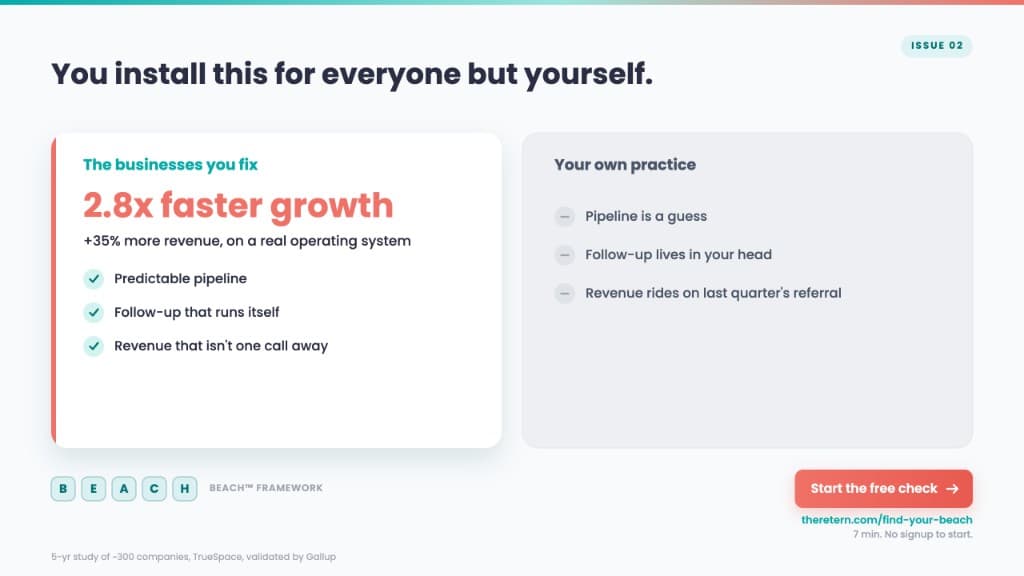
Most independent revenue still rides networks and referrals. Vendor surveys put network-sourced work in the mid-eighty to low-ninety percent range for many consultants and fractionals. Treat every percentage as directional.
The cliff shows up later: among larger practices, a strong share of revenue depends on referrals while a majority still lack a documented process. That is not branding. That is instrumentation.
Partner Circle™ is the small set of people whose job, if they say yes, is to send you work on purpose. Referral Method™ is how you work them: give first, make sure they can describe you, stay in touch when something real happens, thank them when an intro lands. Thin and real beats a fat spreadsheet of names you never develop.
Run the legal-pad audit from where fractional executives actually get clients:
- Last five clients and source
- Three complementary partners who should send work but do not
- One-sentence offer a peer can repeat, plus the give you will lead with
- LinkedIn score for the last thirty days: demand created, or hours burned?
(Dear Emily Post: My networking strategy is "be helpful and the universe will respond." Is that a strategy? Signed, Former vice president of Waiting.)
The universe does not have a customer relationship management (CRM) system. Name the partners. Give first. Close the loop.
Step 4: LinkedIn as owned channel
LinkedIn is not a replacement for referrals. It is the public board where strangers learn how you think and warm contacts remember you exist.
Wrong use: daily engagement theater with no point of view. Right use: a weekly rhythm of posts and conversations that show judgment on the buyer pain you serve.
If you are already "active" and still invisible, start with you are using LinkedIn wrong.
Step 5: Sell like an adult (qualify hard, close easy)
Independent operators often copy corporate sales theater or avoidance. Both fail.
A cleaner pattern:
- Diagnose pain before you propose.
- Confirm budget reality early without apology.
- Name decision process and timing.
- Pull back when the room is not ready. Never chase.
You can learn that method without becoming a caricature of a closer. Inside The ReTern, Migration Method™ is the playbook for those conversations. Outside The ReTern, any serious qualification stack beats "hope they like me."
Step 6: Multi-client run layer (the Tuesday problem)
I keep seeing this on calls. Landing client one is a launch. Landing client three without a map is chaos.
You need:
- A weekly cadence across accounts
- Capacity rules (what a full week means)
- Client health signals before renewals surprise you
- One place for next actions so memory is not the system
Programs that teach launch and stop there leave you here. Communities give peers and occasional opps. Someone still has to operate the practice. That is why an operating system for your own practice matters more after the first invoice than before it.
EOS and Firefly note: those tools help you run a client company. Useful. Different subject. The ReTern runs your practice. Do not force a client OS to babysit your pipeline.
Step 7: AI as chores, not compass
AI drafts emails, outlines, and research dumps. It does not choose which partner to activate this week or which client is at risk. Keep your hand on the map. For the split between engine and judgment, read AI for fractional executives.
What to buy, join, or ignore
| Option | Strength | Gap to watch |
|---|---|---|
| Free peer community (e.g. Fractionals United) | Belonging, collaboration, shared opportunities | Cannot guarantee leads; not a full practice OS |
| Single-discipline launch license (e.g. Sales Xceleration) | Strong zero-to-one playbook and referral-partner habits | Often sales-only; run + LinkedIn + any-discipline continuity after launch |
| Career coach | Interview and story craft for W-2 | Rarely owns independent demand |
| Job boards / marketplaces | Occasional supplement | Race-to-bottom risk; not a strategy alone |
| Practice operating system (The ReTern) | Land, run, LinkedIn, Referral Method / Partner Circle, any discipline | Not a hangout; not an HQ that sends leads |
Praise what works. Name the gap. If you are comparing launch licenses, see Sales Xceleration alternatives. If you are sorting community versus system, see community versus operating system.
Ninety-day build plan (no fantasy calendar)
Days 1 to 30: Offer page. Warm-twenty list. Five asks per week. LinkedIn two posts per week on buyer pain. One qualification call rehearsal with a peer.
Days 31 to 60: First paid diagnostic or pilot. Document delivery steps. Start weekly practice review (pipeline, clients, capacity). Map three referral partners with a reciprocal reason.
Days 61 to 90: Second client or extension only if capacity allows. Kill one channel that only feeds ego. Formalize the referral ask. Write the "full week" rule so you stop overselling.
I keep seeing this on calls. No income target lives here. Cadence does.
Where The ReTern sits in this how-to
Kirk Coburn pioneered the fractional executive movement over fifteen years ago. He introduced the fractional chief marketing officer (CMO) model and founded Chief Outsiders, the firm that placed more than 2,000 fractional executives. He built The ReTern, the operating system for running an independent fractional practice.
We compete on the full practice stack: land, run, LinkedIn, and Referral Method / Partner Circle. Not another Slack with a logo. Not a promise that HQ will fill your calendar.
Naming without corporate cosplay
Operators waste months on logos, color palettes, and "fractional empire" names before they can answer a buyer in one sentence. Order of operations:
- Pain sentence a buyer recognises
- Offer one-pager
- Conversations and proof
- Then polish the brand assets
If you need a temporary name, use your name plus the seat: "Jordan Lee, Fractional CFO." I keep seeing this on calls. Buyers hire judgment first. Identity design can follow invoices.
Delivery standards that keep retainers
Independent practice dies when delivery is heroic and undocumented. Minimum standards:
- Kickoff note with decision rights and out-of-scope
- Weekly or biweekly operating review with written takeaways
- A single place for open actions (not six chat apps)
- A renewal conversation before the end of the term, not after silence
- Capacity math before you accept "just one more client"
This is Harbor territory inside The ReTern: client health as a practice discipline, not a vibe. Outside The ReTern, borrow the job even if you use a different tool.
Cash and capacity without heroics
Write three numbers on a card and update monthly:
- Floor: minimum monthly cash the household needs from the practice
- Target: the practice number that feels sustainable, not fantasy
- Full: the day-count where quality breaks if you add more
If you are below floor, demand process is the emergency, not a new logo. If you are above full, saying no is the strategy. Feast/famine is often a capacity lie told with optimism.
Common failure loops (and the exit)
| Loop | What it looks like | Exit |
|---|---|---|
| Resume sales | Talking about past titles | Talk about buyer's problem this quarter |
| Coffee collection | Thirty chats, zero offers | One-page offer + qualification |
| Delivery addiction | Always busy, never hunting | Protected pipeline block weekly |
| Discount trap | Low fee, growing Slack chaos | Rewrite scope or exit |
| Tool distraction | New CRM every month, same empty pipeline | Legal pad process first |