A client just joined. I asked her why.
She is a chief revenue officer with a thriving practice. Every client came through a referral partner. She already knows software. She already knows business development. She already has Pipedrive, Trello, and Fireflies.
First, the membership. Being connected to other successful fractional executives. She called that the real value. The room: referrals, accountability, pricing, best practices. Referrals from other successful fractional executives, next to happy clients, are the strongest source of work I see.
Then the gap. She said the hardest part is not finding partners. It is remembering who to introduce to whom after the week fills up. She wanted something that looks at the people she already has and says connect this person to this person, so she can send the email and get back to work. She said that tool did not exist for her.
That is the whole story. And it is not a one-off.
Here it goes.
Most of the operators I work with do not use their CRM the way a CRM is supposed to work. Pipedrive, HubSpot, Salesforce: those products were built for teams. A sales manager, a pipeline review, deal stages, a forecast. That is a real job if you have a team.
A Practice of One almost never lives there.
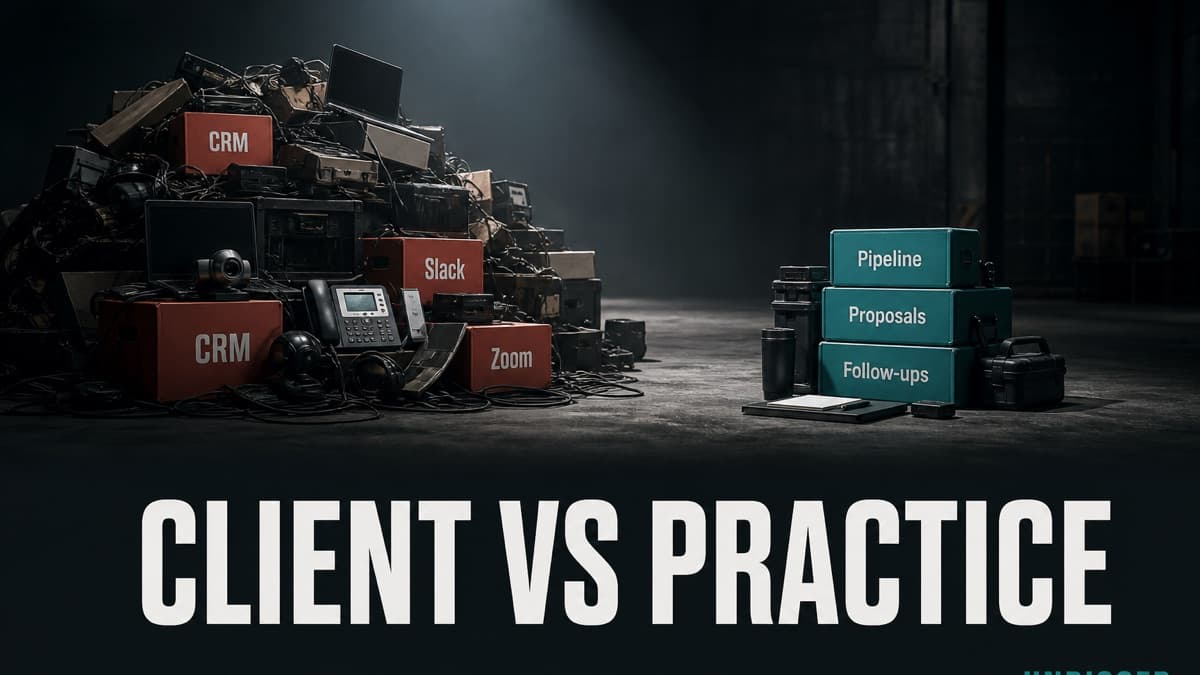
They live in contacts, notes, tasks, and the side spreadsheet where the real list actually sits. They paid for a slot in their head: this is my business system. What they bought is a people book. Memory. Not a heartbeat.
Ask yourself: when was the last time you opened the deals view because that is how you run the week? Or did you open a name because someone emailed you?
I ask two questions on calls once the tools are named. I asked her.
Would you still need this if you had every client you wanted?
Would a client notice if you switched it tomorrow?
Two nos means practice work. Trello and Fireflies are two yeses. Keep them. Pipedrive is the overlap. A live deal is client work. The rest of that database is the people book.
Client work has a deadline. Getting clients does not. Skip the second job and Tuesday feels the same for about six weeks. Then it does not.
According to Consulting Success, 50% of failed consulting startups name poor business development as the main cause. My read: they do not know what to focus on, so they skip it.
That is why I did not design another team CRM. I designed around how my clients actually use the list they already have, and I pointed it at what the curriculum already teaches.
I built an operating system for a Practice of One. It helps the client work you already have: cadence, coaching, pricing. It also reminds you, and helps you, with business development: who to reach out to today and why, who to reconnect with and why, and who else is worth a look.
I have been doing this a long time. I know which activities actually drive revenue, and I built that into the platform.
One client spent a lot of time on LinkedIn writing content and connecting with people. When he uploaded his LinkedIn into The Helm™, it found 105 strong leads already in his network. People he was already connected to. He had never seen them as a list. He was spending most of his time chasing cold outreach, because that is what he had been taught to do.
Once he could see the list, the work was already sitting in his own connections, and warm beat cold.
On the way in we teach the Referral Method™ on a small Partner Circle™: give first, make sure they can describe you, close the loop when an introduction lands. The Map is what to focus on, when, and why. Who to call next. Who to reconnect with. Which introductions are worth making this week.
As more operators join and use the platform, that picture gets sharper: who looks like the people you already help, which introductions are worth making, what to do this week. The platform gets smarter. That makes you better.
That is what she asked for. Not a second project board. Not a deal-stage religion she was never going to run.
Generic AI is useful. It makes you 3 to 10 times more capable. What it does not have is the Map. It will summarize the call. It will draft the email. It will not tell you who to introduce to whom after the week fills up.
Keep Trello. Keep Fireflies. Keep Pipedrive if a live deal still lives there. I am not asking you to rip out the people book you already paid for. I am asking whether anything forces the weekly job that book never will.
The membership is the room. That is why she joined. The operating system is the Monday list: what to focus on, when, and why. I sat across from a CRO who has the clients and still named that gap.
If you are already spending $450 a month, you may be paying twice for the same people book and still missing the practice heartbeat. If you are lean, this is net new spend. What I am offering you is the six weeks, the room, and the list she asked for.
The work is serious. The life does not have to be.
See where your practice stands.
See where you stand