The number nobody told me when I started Chief Outsiders.
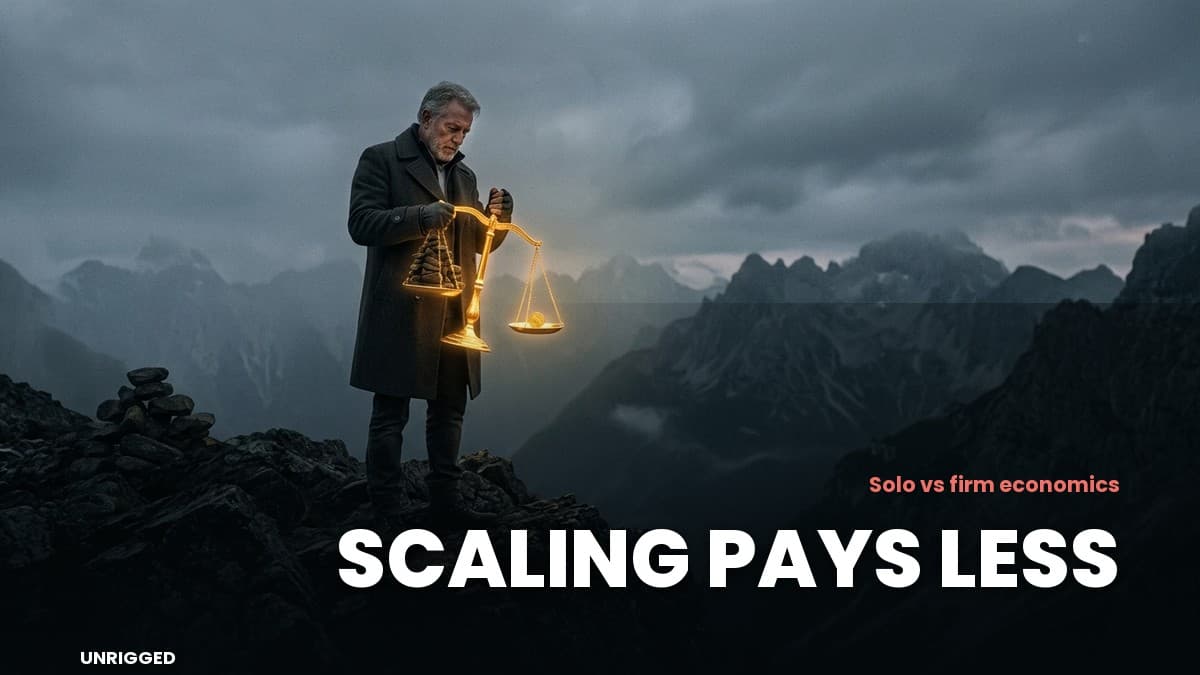
When you go from solo fractional executive to founder of a firm, your personal take-home does not go up with revenue. It goes down.
Sometimes for years. Sometimes forever. And the reason is not the one most people think.
Run the Math the Way I Had To
A senior solo chief financial officer (CFO) doing $700K a year in revenue takes home roughly $400K. Lean overhead, no payroll drag, no recruiting bill, no software stack built for fifty people. They keep about 57 cents of every dollar.
Now scale that same operator to a five-practitioner firm doing $1.9M. Looks bigger. Sounds bigger. The cocktail-party number is bigger.
The founder's take-home? Roughly $290K. That is $110K less, every year, for the privilege of running a bigger thing.
| Model | Revenue | Founder take-home |
|---|---|---|
| Solo CFO | $700K | ~$400K (57¢/$) |
| 5-practitioner firm | $1.9M | ~$290K |
"Your take-home doesn't go up with revenue. It goes down."
The Part Nobody Tells You
The moment you hire your second practitioner, you are no longer a fractional executive. You are the head of sales.
Your partners expect you to fund and run the marketing engine that fills their pipeline, because most of them did not join you to do business development. They joined the lead flow. And if the lead flow dries up, they leave.
That changes everything. You stop doing the work you were good at. You start spending money on marketing, content, paid acquisition, conferences, and a sales infrastructure that costs real money and takes 18 to 24 months to compound.
You become a marketing-funded sales organization that happens to deliver fractional services, instead of a fractional executive who happens to have a few teammates.
You are Not Graduating. You are Switching Businesses.
Solo is a high-margin lifestyle business. A firm is a low-margin growth business with payroll, pipeline risk, a marketing budget you did not have before, and a brand that has to stand on its own when you are not in the room.
You are not graduating from solo to firm. You are quitting one business and starting a different one, where your job changes from operator to rainmaker, with worse personal economics for the first three to five years and no guarantee the curve ever bends.
"You're not graduating from solo to firm. You're quitting one business and starting a different one."
The firm pays off in two scenarios. You hit eight to ten producing practitioners and the leverage finally compounds. Or you sell. Below that, you are buying optionality with your own paycheck.
Two Questions Before You Hire Anybody
If you are sitting at $700K solo right now and thinking growth is the obvious next move, ask yourself:
- Have you actually modeled what your life looks like at $1.9M?
- Are you ready to stop being a fractional executive and become a head of sales?
I built the model I wish someone had handed me in 2009. That is the conversation nobody wants to have, so I am having it.
Get the frameworks I run with operators at that threshold: theretern.com/newsletter
The work is serious. The life does not have to be.
Now if you will excuse me, I have a tee time to keep.
Kirk Coburn is the founder of The ReTern and category creator of the fractional executive movement. He introduced the term "Fractional CMO" to the market in 2009 when he co-founded Chief Outsiders, which has since served 2,000+ clients. When he is not helping corporate refugees build fractional practices, he is usually on the golf course by 2 PM.