If you run a fractional or independent practice, your feed is full of the same promise: run your business from AI, your fractional AI officer, automate the whole thing.
Some of the tools are good. You should use them. Hard. That is not the argument here.
The argument is what comes after you automate the chores.
Use AI for the work that does not need you
Be honest about how much AI can take off your plate. Scheduling, follow-up drafts, call summaries, proposal first passes, bookkeeping prep, turning a voice memo into a clean plan. If a task is repeatable and low judgment, hand it over. That includes tracking effective hourly rate by client: retainer divided by the hours you actually work, ranked so you can compare. With two or three clients you can hold revenue in your head. The gap is not arithmetic. It is knowing which client pays you least per hour when you count the real work. AI does that math weekly. Repricing or walking away is still yours.
I keep seeing this on calls. Ignoring AI is not discipline. It is leaving time on the table.
The IBM gap: everyone has the engine, almost nobody has the map
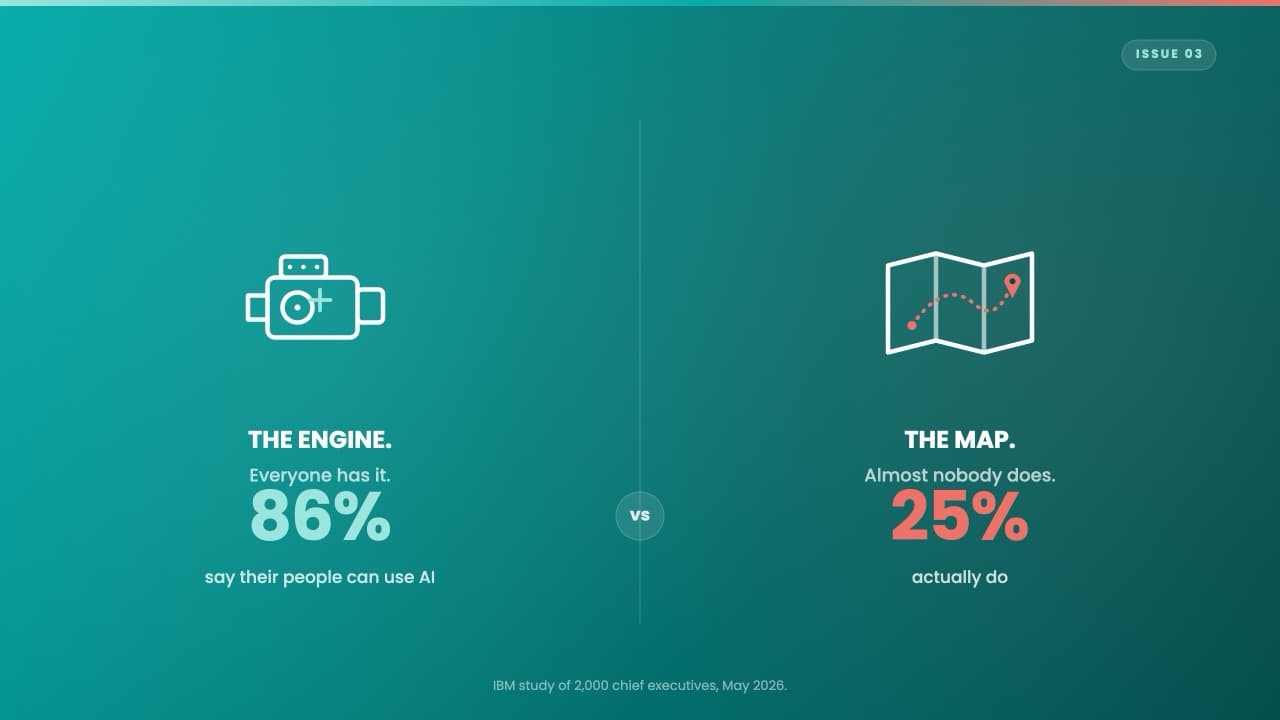
In IBM's 2026 chief executive officer (CEO) study (two thousand CEOs, thirty-three countries), eighty-six percent said their people have the skills to work with AI. Twenty-five percent actually use it regularly in daily work.
IBM's read is not "train harder." It is redesign the workflow first, then point AI at it. Map where the machine executes, where a human integrates context, and where you escalate. Eighty-three percent of those CEOs said AI success depends more on people and adoption than on the technology.
Same pattern I see in fractional practices. Same tools. Same access. A sixty-one-point gap between "we could" and "we do."
What a chatbot cannot run
I keep seeing this on calls. Your practice is not a pile of tasks. It is a sequence of decisions.
A general-purpose AI can do the typing and the math. It can log hours, divide retainers, and rank clients by effective rate. Do you know which client pays you least per hour, and which one you would stop taking tomorrow if you had to choose? An optimal practice can answer that. You would not run a client's company without a financial plan and a target worth building toward. Growth-oriented small firms were almost twice as likely to run a written plan as declining ones (49% vs 28% in a study of nearly a thousand firms). AI makes the tracking manageable. The calls about reprice, fire, or protect your time are still yours.
A blank chatbot will draft your follow up. It will not tell you:
- Which of your targets deserves Tuesday when three look fine on LinkedIn (fit and warmth, not headlines).
- Whether to keep taking partner meetings or insist on the decision maker who signs.
- What to leave out of the pitch so you do not kill the deal with the extra thing they did not ask for.
- What a quiet prospect actually means: gone, price-stuck, waiting internally, or still in play with a different frame.
- What to focus on this quarter when everything at 7am feels urgent (priority, not inbox order).
Point AI at the chores: effective rate by client, summaries, drafts, scheduling.
You run the calls: discovery, conversion, fit, focus.
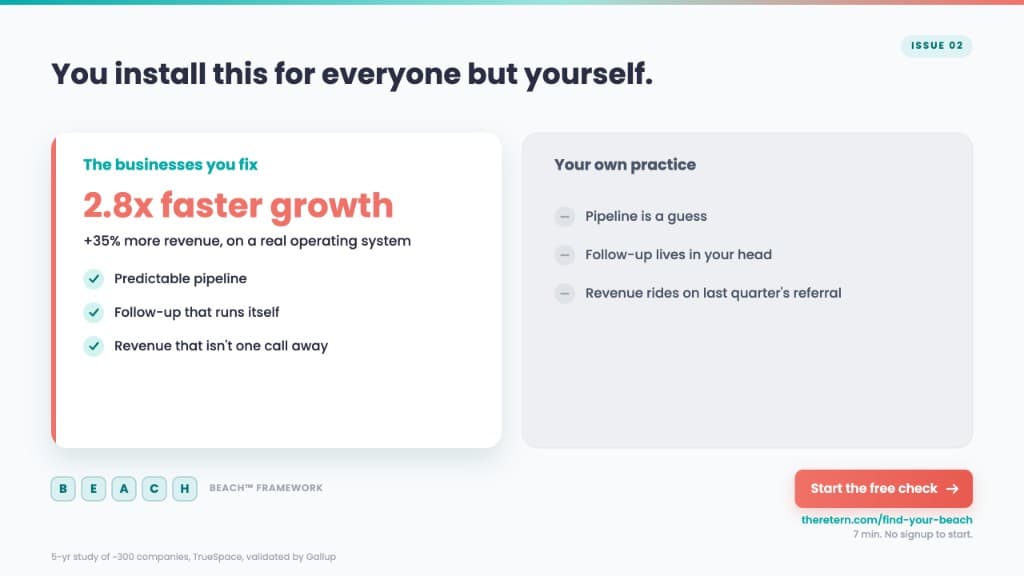
That is the layer you build when you run on a system, not on memory and hustle. If you read last week's piece on running an operating system for everyone but yourself, you already know the asymmetry: you install the system for clients, then run your own practice on hustle. Issue two was turning the lens on yourself. This is the next mistake: thinking a chat window is the system underneath that lens.
Dennis Wong, a former Best Buy divisional CIO on our crew, put it plainly on a call: AI output hallucinates, floats, and makes bad assumptions. You cannot assume the answer is right. You still need a critical eye. When someone who ran technology at that scale says that, it matches what the data says.
The fix: model first, AI second
The operators who win with AI do the unglamorous thing first. They run their practice on a proven operating model, then point AI at it. Diagnose before you automate. Tool first wastes a year. Model first turns AI into a force multiplier instead of faster chaos.
I keep seeing this on calls. The robots do your chores. You make the calls.
Do one thing this week
Name one judgment call in your practice that AI should not make for you. Not "summarize my call." Which prospect gets Tuesday. Whether to take the partner meeting or go to the buyer. What to leave out of the pitch. Write it down. Automate the math and the drafts.
If you want a straight read on where your practice stands before you point AI at it, the free check takes a few minutes and shows you the weakest area first: Where does your fractional practice stand?