
If you are looking for the best community for fractional executives, here is the honest answer: Fractionals United is the biggest room. Thousands of independent operators in one free Slack, and if what you want is peers who get it, that is where they are. There are good ones. Fractionals United for volume, smaller vetted rooms for depth, marketplaces like GoFractional and Bolster if you want to be matched to work.
Now the question almost nobody asks, and it is the one that decides whether you are still doing this in two years.
Most communities give you a room. A place to hang out, compare notes, feel less alone. That is real, and it is worth having. But a room is usually where the help stops. What actually builds a practice is three things working together: the room, a Partner Circle™ that sends you real deals (run with the Referral Method™), and a system that turns both into paying clients. Most fractional executives do not fail for lack of a room. They fail because the room was all they ever got.
What a community actually gives you
A good community gives you three real things: belonging, so you feel less alone in a lonely job; peers, who have hit the same walls and can tell you what worked; and the occasional referral when someone in the room cannot take a deal.
That is worth having. Go join one. I mean it, not as a consolation prize, as a genuinely good use of your time.
But look closely at what it does not give you. A community does not give you a position the market pays a premium for. It does not give you a pipeline that stays full when you get busy delivering. It does not tell you your number, the take-home your practice actually has to hit for you to be free, or the math for how many clients that takes. It does not keep a client from quietly turning you into an employee. A room full of smart peers is not a business. It is a room.
The wall a community cannot get you over
Here is the thing I have watched happen to hundreds of talented operators. They go independent, they join every community they can find, they get good advice, and eighteen months later they are still on the feast-or-famine treadmill. Not because the advice was bad. Because advice with no system underneath it evaporates.
The fractional executives who win are not the most connected. They are the most findable, the most referable, and the ones running an actual practice on process instead of memory and hustle. That is not a personality trait. It is a system, and it can be built.
What an operating system for a fractional practice actually is
This is the category we built The ReTern to own, and it is a different thing from a community. An operating system runs your practice on five domains, and you can hold them in your head:
- Bearing™, who you are and where you stand.
- Earnings™, the number you are building toward.
- Authority™, a pipeline that stays full.
- Crew™, the people who have your back.
- Harbor™, keeping and growing the clients you win.
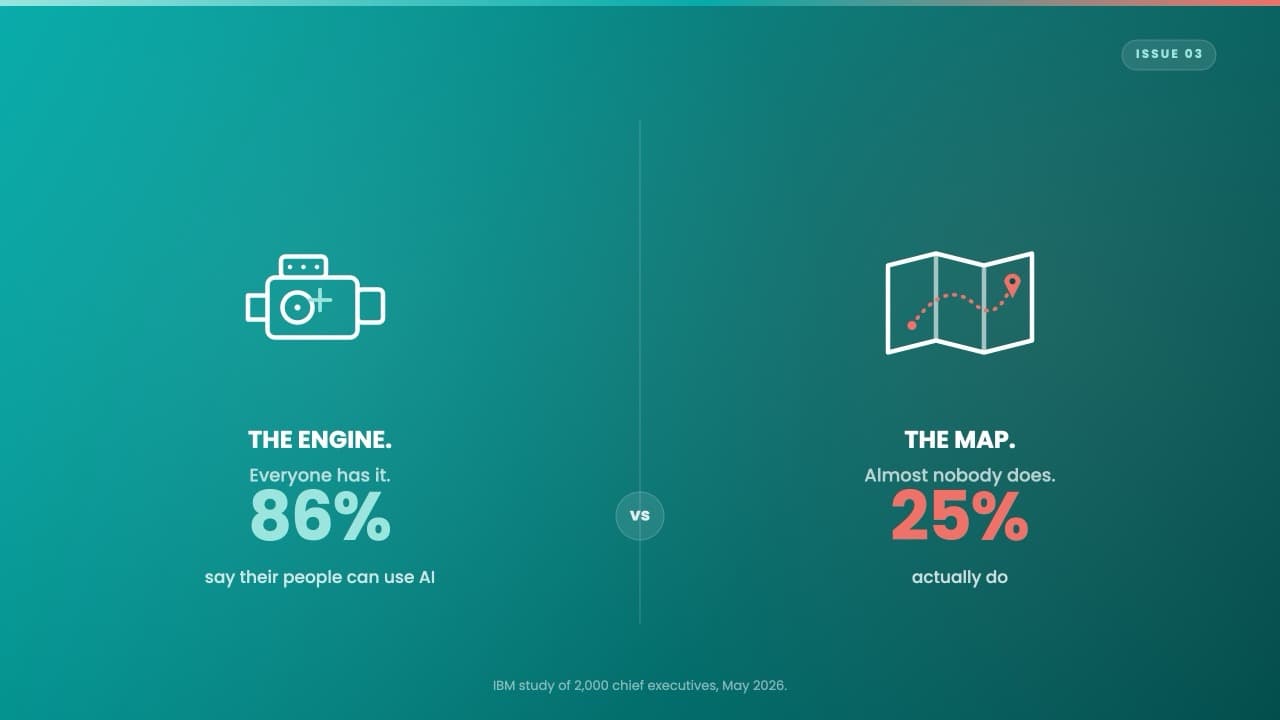
And it starts with a Map. Before you talk to a single prospect, you build one page: who you serve, what you sell, your Freedom Number™, the take-home that funds your life, and the math for how many clients that takes. That math is usually smaller and more freeing than you think. Eighteen thousand dollars a month divided by a nine thousand dollar offer is two clients. Two clients, and you are free. A community will never hand you that page. A system builds it in one sitting.
You should not have to choose
The old advice is to join a community for the peers, then go build your practice somewhere else, on your own. That is backwards. The room, Partner Circle, and the system are not three separate things you assemble alone. They are strongest as one: peers who have your back, partners who send you work on purpose, and a system that turns those intros into a practice you own.
That is the community I built. Fractionals United is the biggest room, and if a room is all you want, go join it. If you want the room plus Partner Circle plus the system that turns them into clients, and the number that tells you when you are actually free, that is The ReTern.
I pioneered the fractional executive movement over fifteen years ago. I introduced the fractional chief marketing officer (CMO) model and founded Chief Outsiders, the firm that placed more than 2,000 fractional executives. I did not build The ReTern because the world needed another room. I built the community that keeps going after the room: the peers, Partner Circle, and the system that turns them into a practice you own. I watched too many great operators drown in the second job of finding work, and the difference between the ones who made it and the ones who burned out was never talent. It was having all three.
Start with your Map
You do not have to decide anything today except one thing: where does your practice actually stand, and what is the one thing to fix first.
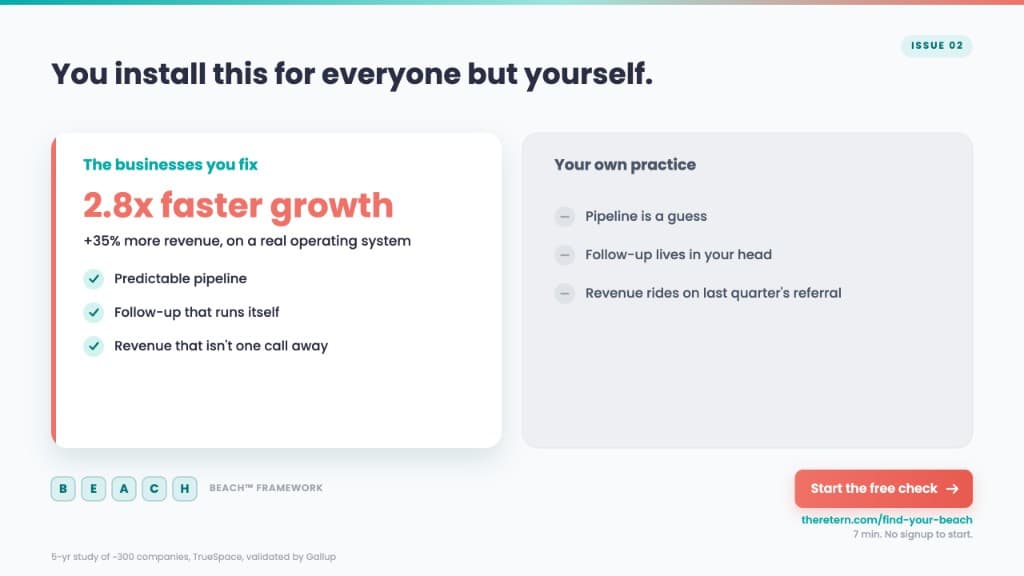
Take the free assessment, Find Your BEACH™. Seven minutes, no signup to start. It reads the five domains that decide whether you land clients, and it shows you the gap that matters most. Then you will know whether you need another room, or a system to build in.