
Most fractional executives asking "how do I get clients?" are really asking three questions at once: where does work come from today, what happens when referrals slow down, and what system do you run on Tuesday morning?
This is the audit I use before I recommend anything else. You can run it tonight with a legal pad.
The question behind every fractional forum thread
"How do I get clients?" is not one question. It is three:
- Where does work come from today?
- What happens when referrals slow down?
- What system do you run on Tuesday morning?
If you cannot answer all three in plain language, you do not have a strategy. You have a prayer circle with better coffee.
What the surveys say (directional)
Vendor surveys converge on one pattern: most fractional and consulting revenue still flows through networks and referrals. Fractional Jobs and Consulting Success cite figures in the 84% to 93% range for network-sourced clients. Treat every percentage as directional, not gospel.
Go Fractional's 2026 State of Fractional Work Report (survey of 213 fractional professionals, vendor-produced, directional) names client acquisition as the top pain point for independents. That matches what I hear on calls every week.
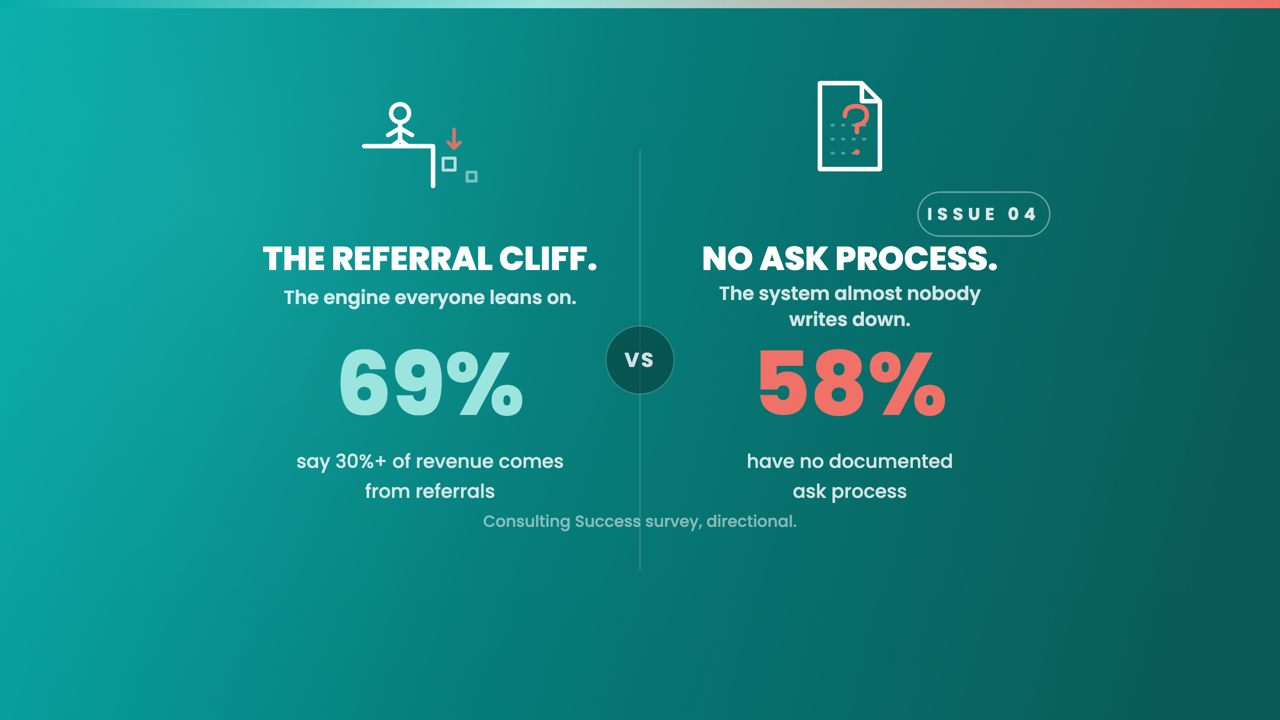
Among consultants past roughly $1M in revenue, Consulting Success reports that about 69% say 30% or more of their revenue comes from referrals, while about 58% report no documented process for requesting them.
That is the referral cliff: high dependence, low instrumentation.
The referral-process gap
I keep seeing this on calls. Referrals are not bad. Passive hope is.
Waiting for a past client to think of you is not a strategy. Naming a Partner Circle™, giving first, making sure they can describe you, and closing the loop when an intro lands: that is the Referral Method™.
Dan Miller, a career coach I have followed for years, tells a story theologian John Drescher used to tell. A corn farmer won blue ribbons year after year, yet shared his best seed corn with every neighbor. Someone asked why. The farmer said poor corn next door would pollinate his field and pull his crop down. Referrals work the same way. You plant in your network. You give first. Then you stay in the conversation on a rhythm. The farmer had a process. Most of us have a vibe.
I pioneered the fractional executive movement more than fifteen years ago. I have watched hundreds of strong operators stall for one reason: they built a network, not a process.
I will tell you where I got this wrong myself. I have always been naturally good at networking. The rooms, the intros, the follow ups: that came easy. Turning that into partners who send work on purpose did not. That took years of trial and error. Process beats network, and I learned it the hard way. Inside The ReTern, Partner Circle™ and Referral Method™ are built from what actually worked after everything that did not. Not theory. A process we run every week.
(Dear Emily Post: My referral strategy is word of mouth. Is that a documented process or a prayer circle? Signed, Confused in Texas.)
Word of mouth without a Referral Method is a weather report, not a steering wheel. It tells you what happened last quarter. It does not tell you who to develop Tuesday.
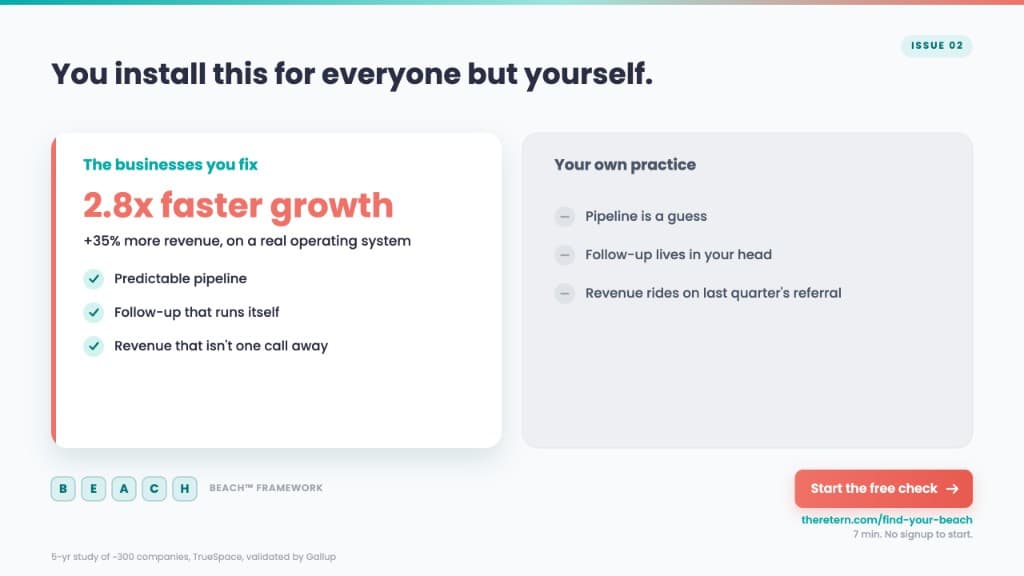
If you already run a tight operating system for every client on your roster but run your own practice on memory and last quarter's referral, start with the mirror audit on running your own practice. This article picks up where that leaves off: where the work actually comes from.
What free communities deliver
Fractionals United and similar peer groups are valuable for belonging, collaboration, and occasional shared opportunities. Founders are honest that they cannot guarantee leads. That is a feature of peer support, not a bug.
The mistake is expecting a free room to become a revenue engine. Belonging compounds. Pipeline does not, unless someone teaches you to engineer it.
What launch playbooks deliver
Programs like Sales Xceleration excel at zero-to-one: brand, methodology, referral-partner mapping, peer encouragement. They generally do not operate your multi-client practice after launch, and they are often single-discipline.
Land matters. Run matters longer. After the first client, you are juggling cadences, capacity, positioning, LinkedIn visibility, and referral partners across disciplines. Nobody sells that as a daily system.
The fix: audit before you buy another membership
Run these four steps on a legal pad tonight:
- List your last five clients and their source (referral, inbound, board seat, marketplace, other).
- Name three complementary partners who should send you work but do not (Partner Circle candidates).
- Write the give you will lead with, plus the one-sentence offer they can repeat. If blank, you are passive. That is the one action this week.
- Score LinkedIn for the last 30 days: did it pull demand, or only consume time?
Step three is the whole game. Referrals without give-first and clear transmission is winging the map. You leave with a map. You run it on a rhythm. The system tells you the next move.
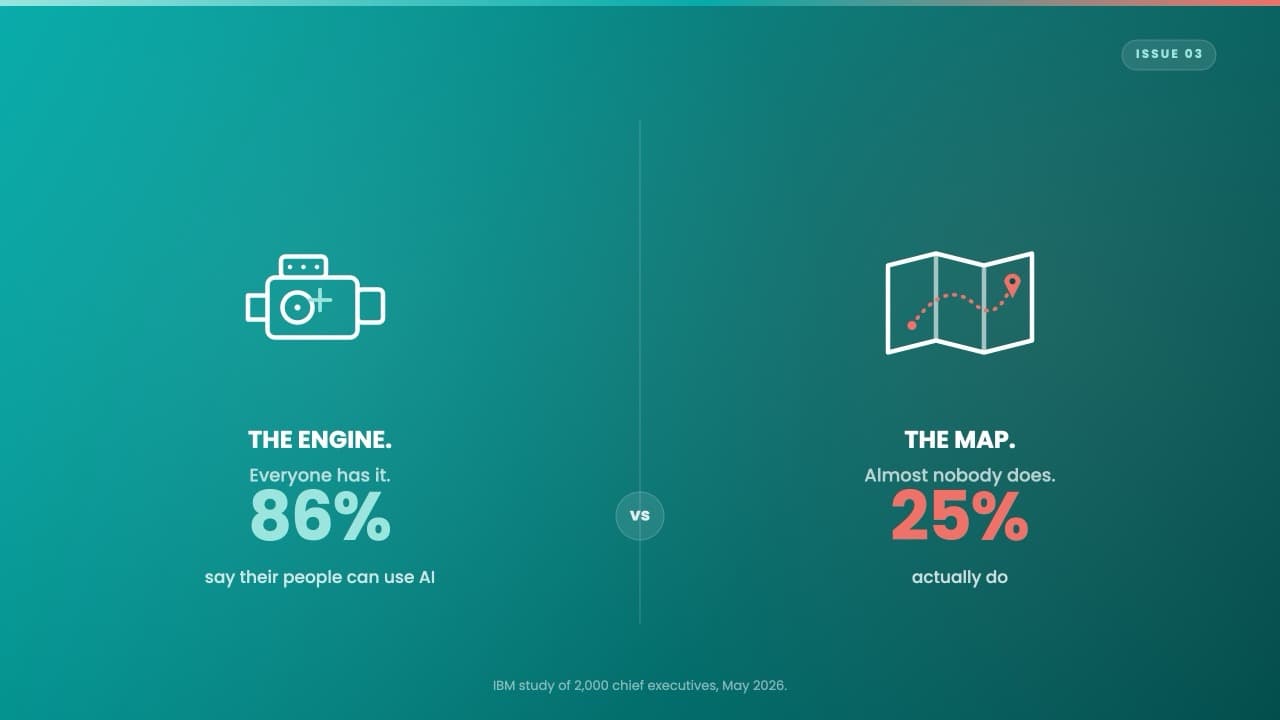
If you are also sorting where AI fits (and where it does not), read what AI can run versus what only you can judge. The engine is free. The map is not.
What The ReTern is
The operating system for the whole practice: BEACH diagnostic, weekly cadence, client health, LinkedIn as owned channel, Migration Method™ for sales conversations, Referral Method™ for Partner Circle™. Built by the person who pioneered the fractional executive category over fifteen years ago.
We compete on the full practice OS: land, run, LinkedIn, Partner Circle work, any discipline. Not another hangout with a price tag.
FAQ
Do fractional executives get clients from job boards?
Sometimes, as a supplement. Practitioner complaints about marketplaces ("race to the bottom," "zero leads in 90 days") show boards alone are not a strategy.
Is a paid community worth it?
When it bundles a named system and outcomes, operators tolerate four-figure spend. When it is access-only, reviews trend toward "echo chamber."
How is The ReTern different from Sales Xceleration?
Sales Xceleration is a proven launch and client-delivery license for sales advisors. The ReTern is a discipline-agnostic operating system for land, run, LinkedIn, and referral engineering for the life of the practice.
Where does your practice actually stand? Take the free 7-minute BEACH check: theretern.com/find-your-beach?utm_source=blog&utm_medium=organic&utm_campaign=independent-chief&utm_content=fractional-client-acquisition-audit
P.S. I asked a chatbot to draft my Partner Circle give. It suggested I leverage synergies with key stakeholders. I am keeping the legal pad.
Stats in this article are vendor-produced and directional unless otherwise noted. No earnings promise. Past operator patterns do not guarantee your results.