You install operating systems in other people's companies for a living.
You walk into a business that is a mess. The founder is chasing ten tactics at once, the pipeline is a guess, the follow up lives in someone is memory, and the revenue depends on who happened to call this month. You install the system underneath all of it, and the chaos turns into something that runs.
I keep seeing this on calls. You have done it again and again. It is the thing you sell.
So here is the question almost nobody asks themselves. When did you last do that for your own practice?
The asymmetry nobody talks about
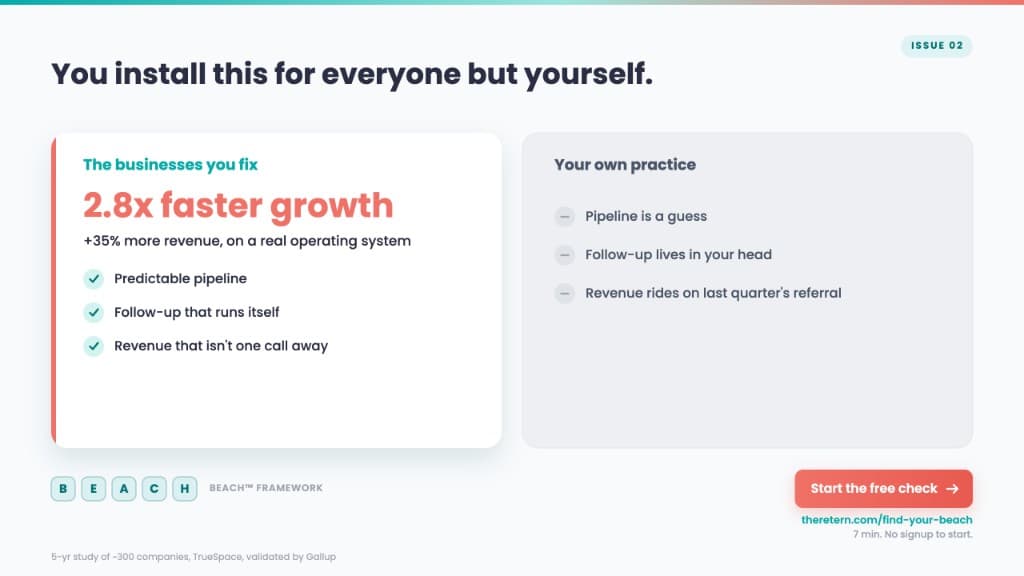
Here is what I see, over and over, from genuinely excellent operators. They run a tight system for every client on their roster, and they run their own business on hustle, memory, and whoever referred them last quarter. They install the operating system for everyone else. They never built one for themselves.
It is not that they cannot. They obviously can. It is literally their job. It is that the lens they point at every client has never turned around to face them. The cobbler's children have no shoes, and the cobbler is a world-class shoemaker.
I keep seeing this on calls. And that gap is not harmless. It is expensive.
A five-year study of about 300 companies found that the ones running on a real operating system grew 2.8 times faster, with roughly 35 percent more revenue growth, than the ones running on hustle.
That study tracked companies running on the Entrepreneurial Operating System against a matched control group, validated by Gallup. The number is about businesses in general, not a promise about yours. But the direction is the whole point. A system is not bureaucracy. It is the thing that lets a business grow on purpose instead of by luck. You hand that advantage to every client you take. Then you go home and run your own practice on memory and last quarter's referral.
A system is simpler than it sounds
When people hear "operating system" they picture software, dashboards, a stack of tools. That is not it. A system is just the small set of questions a business can answer without guessing:
- Where does the next client come from, and can we repeat it on purpose?
- What happens after a good conversation, and who makes sure it happens?
- How exposed are we if our biggest client disappears?
You answer those for clients in your sleep. The system is just those answers, written down, so they do not depend on anyone remembering. The reason your own practice does not have one is not difficulty. It is that you have never pointed the question at yourself.
The day-one audit, run on yourself
So this week, run your own day-one audit. The same one you would run on a client. Ten minutes, three questions, answered honestly.
First, your pipeline. Write down where your last five clients actually came from. If the honest answer is a referral you could not repeat on purpose, or you are not sure, then you do not have a pipeline. You have luck that has held so far. (If that stings, your pipeline is probably lying to you, and it is worth a closer look.)
Second, your follow up. Pull up the last three good conversations that did not close. Can you say, right now, what the next step is for each one and when it happens? If the answer lives only in your head, it is already leaking. The deals are not dead. They were just never put on a system.
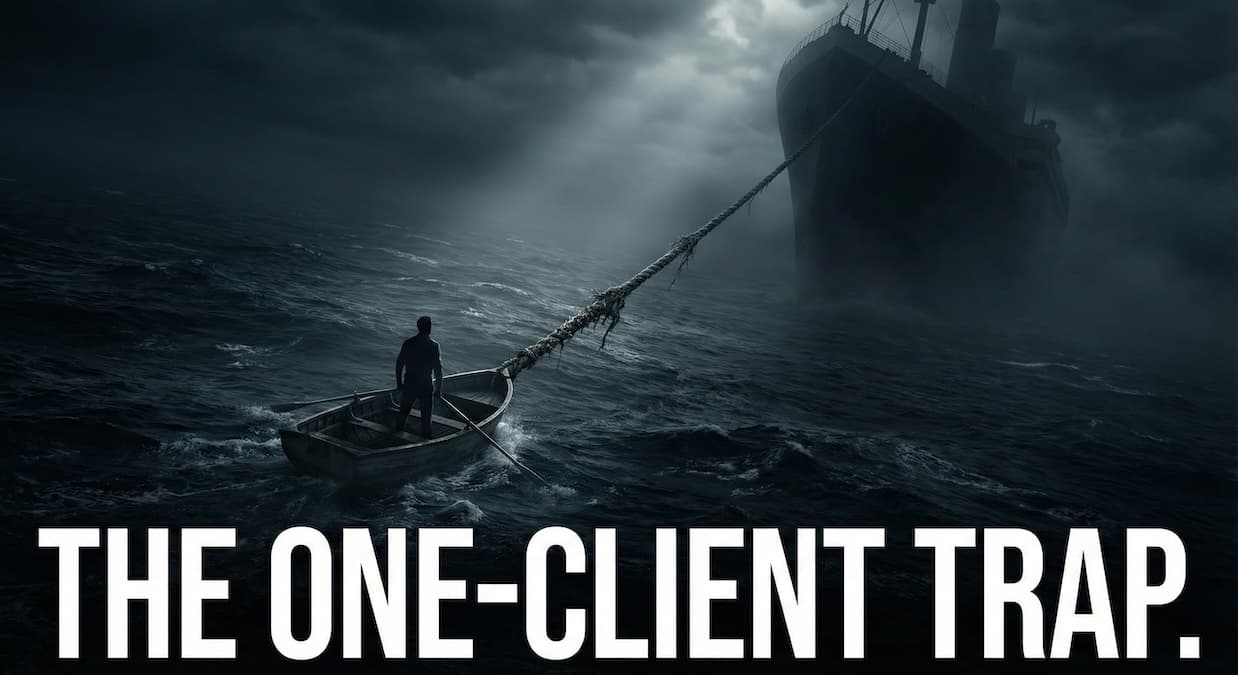
Third, your concentration. Add up what your single biggest client is as a share of your income. If it is more than about a third, one lost email can cut your revenue in half. That is a risk you would never let a client carry, and the one-client trap catches more independent operators than almost anything else.
I keep seeing this on calls. You diagnose this for other people without breaking a sweat. Give yourself the same ten minutes.
Why this is the highest-leverage hour of your quarter
Most independent operators spend their energy on the front of the business: more outreach, more posts, more activity. That is the volume game, and it is the wrong machine. The operators who build something that lasts do not have more leads. They have a system that turns the leads they get into predictable revenue.
The audit above is not busywork. It is the cheapest version of the work you charge clients five figures to do. An hour of pointing your own lens at your own practice will tell you more than a month of posting. And unlike most advice, you do not need a single new tool to start. You need a piece of paper and the honesty to answer three questions the way you would make a client answer them.
Do one thing this week
Pick the ugliest of the three answers. Just one. The pipeline you cannot explain, the follow up that lives in your head, or the client who is too big a share to be safe. Write down the first move you would tell a client to make, then make it yourself this week.
Run your practice like the businesses you fix.
If you would rather have that read done for you, scored across all five areas with your weakest one named first, the free check takes a few minutes and shows you where to start: Where does your fractional practice stand?