This page is about the half of the work nobody posts about. Use it to see why your week fills with cleanup and follow up while the calls that pay stay at the bottom, and what to change this week instead of reaching for another tool.
Across a Nor'easter, a plateau, and a new study of 5,875 workers, the same pattern shows up: the work that keeps a practice alive is maintenance, and maintenance does not feel like progress. SHRM found 65% of workers spend about four hours a week fixing AI output. The four hours is not a tool problem. It is a memory problem, because you are the one holding the context the tool forgets.
I rode out my first Nor'easter on Nantucket this year.
I grew up surfing hurricane swells. I have watched giant pine trees come down and take a neighbor's house with them. I was the last car across the bridge as Harvey slammed into Houston and put the city under water. So when I heard a Nor'easter was coming, I will be honest with you. I was a little excited.
Then it hit, and it was not that. It was wind for two days. It was staring out the window wondering how 34 weddings were going to take place on the island during the 50 plus mile per hour winds. Nothing heroic. Nothing I will tell a story about at a bar.
It was, in a word, maintenance.
The storm I wanted and the storm I got
I wanted the storm, because storms are interesting and storms are how you find out what you are made of. What I actually needed was the regular weather that keeps a house standing. The two-by-fours and the flashing and the gutters are not the exciting part. They are the reason the house is still there the next morning.
George Leonard wrote the book on this. He was a writer and an aikido teacher, and in Mastery he said you have to be willing to spend most of your time on a plateau, to keep practicing even when you seem to be getting nowhere. Then the line I keep coming back to: to love the plateau is to love the eternal now, to enjoy the inevitable spurts of progress and the fruits of accomplishment, then serenely to accept the new plateau that waits just beyond them.
That is the Nor'easter. I stood there wanting the breakthrough. What I got was the plateau, and the plateau is what keeps your house standing.
Somebody finally put a number on the cleanup
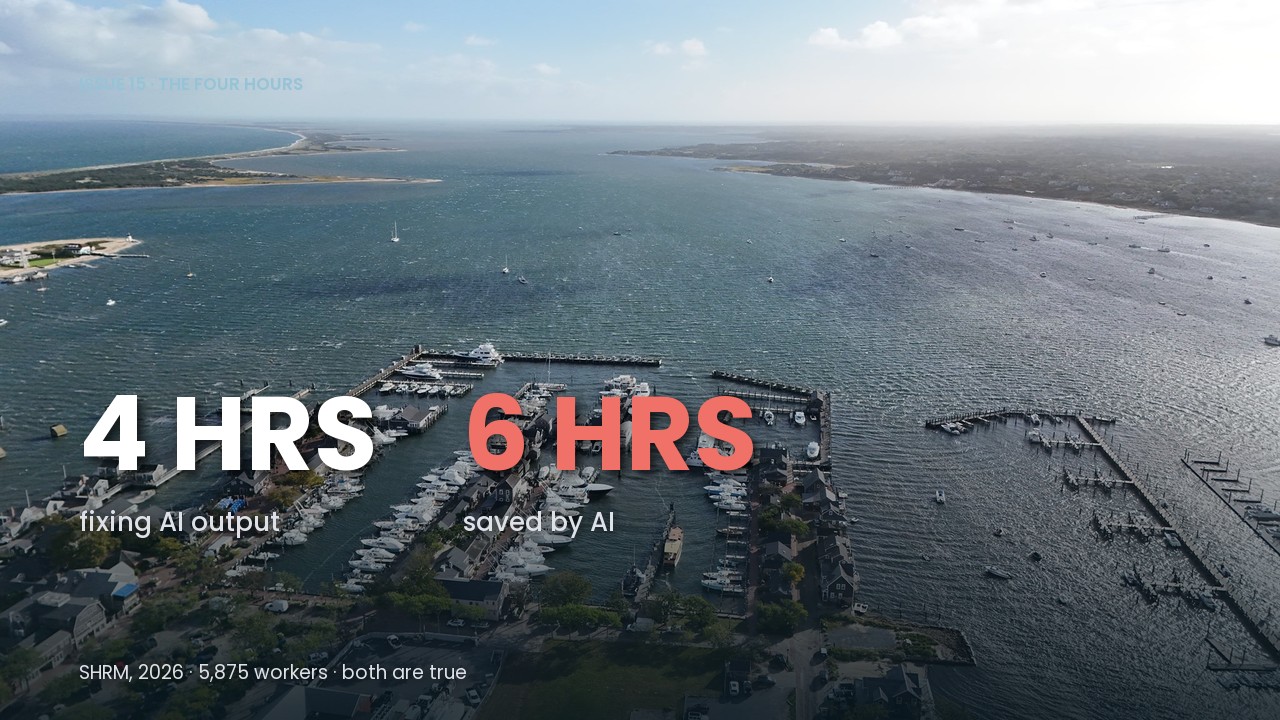
SHRM surveyed 5,875 workers this spring and asked how much effort they spend reviewing and editing what AI hands them. 65% said they spend moderate to significant effort on it. When the study put a clock on that effort, it came out to about four hours a week.
Now the part I am going to say before anyone accuses me of cherry picking. The same study found those workers estimate almost a full workday saved each week, about six hours. The study is explicit about it, and the section is titled accordingly: the time saved is greater than the time spent reworking. AI is a good deal on the clock. I use it every day and I am not going back.
So I am not writing this to tell you AI is a waste. I am writing it because four hours of cleanup is a real thing that shows up in your week, and nobody budgeted for it. Same study: 41% of workers use AI at work, and just under half of those users said their own output includes what the study calls slop. Only about half said they feel confident in what they get back.
And here is the number that stopped me. Directors and above spend the most time correcting AI output, six hours a week, and they also report saving the most, nine hours a week. The more you use it, the more it helps and the more it costs. The two numbers climb together.
Why your cleanup is a four hour job
The tool in the other window does not know your practice. It does not know what you told a client in March. It does not know which conversation you already answered and which one is still open. It does not know that the promise you made three Tuesdays ago is now late. It does not know that the warm intro you have been meaning to answer is the one person who could change your quarter.
So you paste. You paste the thread, you paste the context, you paste last week's version of yourself into the window so the tool can be you for four minutes. Then the tab closes and it forgets all of it, and tomorrow you paste it again. The four hours is not an intelligence problem. It is a memory problem, and today you are the memory.
I used to catch myself doing this. It is 7am. I open the chat window. I draft three polished notes before breakfast. It feels like a good morning. Then I look at the clock and it is 9:30 and I have not made a single call.
I stopped doing that, and it was not willpower. It was a decision about what the machine is for. AI is a brilliant assistant and a terrible boss. It will happily make more things for you all day, and none of them will be the call. The drafting was never the work, and neither is the cleaning up afterward. There is more of that than anyone admits.
So I stopped asking the tool to produce work. I asked it to hold what I owe. That is the whole shift, and it is the reason this issue is about memory instead of prompts.
Two calls, two practices, the same disease
I watched this land twice in one day, on two calls, in two different practices.
The first operator has a working agency and a practice on the side. She built the sequences. She built the CRM. In her own words, the hurdle is logging in and actually using it, and her cold email has produced zero clients so far. She asked me, almost as an aside, whether my system pulls from LinkedIn and email on its own, so that she is not the one typing it in. That question is the whole issue. She is not short on tools. She is the memory, and she is tired.
The second operator had one client doing well, and that client is ending. No pipeline behind it. He said the thing that stuck with me: he does not reach out enough, and he does not have anyone to reach out to. Then, two minutes later, he told me about two former executives he is close with, one at a national retailer and one who has been at one of the largest companies in the world for years. He has never asked either of them for an introduction.
The people were always there. Nothing was holding them, so nothing surfaced them.
The band that stayed on the plateau
Teenage Fanclub is from Glasgow. Norman Blake, Raymond McGinley, and Gerard Love started it at the end of the eighties, and the sound is layered guitars and big multi-part harmonies, the kind of thing you would get if Big Star and the Byrds had grown up in Scotland. Their 1991 record Bandwagonesque finished first in Spin's album poll that year, ahead of Nevermind. Kurt Cobain is widely quoted saying they were the best band in the world.
Then grunge happened, and then Britpop happened, and neither one was their lane. Teenage Fanclub did not pivot into either. They kept making the records they were built to make, for a smaller audience, for decades, and they are still doing it.
They stayed on the plateau. That is why I am bringing them up in the same letter as a boring storm. They wanted the hit the way I wanted the Nor'easter, and what they did instead was the unglamorous part, over and over, long after the attention moved on. The records they made on the plateau are the ones people still play.
That is the same choice in front of you every time a new tool lands and you decide whether to rebuild your week around it. The engine got very good this year. Everyone has it now. What almost nobody has is the map, and the map is the part that remembers what you owe.
What I built, and what it does not do
I got tired of being the memory, so I built the thing that holds it. The Helm™ reads your email, your calendar, your call transcripts, and your conversations overnight. Transcripts matter here, and I want to be specific about why, because most tools treat a call as a write-off once it ends. A call transcript is where the promise actually got made. It is where you said you would send the proposal by Friday, and where they told you the budget year starts in January. If your system does not read the transcript, it does not know what you owe.
Then every morning it puts a short list in front of you with one next move beside each name, and it sorts by how close the person is to revenue. A proposal that is out and unanswered. A promised follow up that is past its date. A renewal inside sixty days. A keep, raise, or expand conversation that is due with a client who is already paying you. Those come first, because they are the closest to money. Reply owed sits below them. Same read for every member, mine included.
The honest part, because I am not going to sell you magic twice. That list does not write your email, and it does not clean up after the tool that did. It does one job, which is remember what you owe and who is owed it, so the draft you write before breakfast is the right draft instead of a polished version of the wrong call. On the mornings I use it that way, I still write. I just stop writing things that did not need to exist. If your pipeline already feels like it is lying to you, that is the same problem from the other direction, and it is worth an afternoon: when your pipeline is lying to you.
One more thing, and I have been sitting on it
A devotional passage landed on me this month, and I think it belongs here, because the storm and the plateau and the keeping are the same argument. Two verses, close together.
The Lord God took the man and put him in the garden of Eden to work it and keep it. Genesis 2:15
And the one that came before it, before the fall and before the curse:
Be fruitful and multiply and fill the earth and subdue it, and have dominion over the fish of the sea and over the birds of the heavens and over every living thing that moves on the earth. Genesis 1:28
Read the order, because the order is the argument. Genesis 1 gives the commission. Genesis 2 gives the assignment. Work exists before sin enters the story. It exists before thorns and thistles and the sweat of the brow. Which means the modern instinct to treat labor as the price of admission to a better life is a reading error. Work is not the penalty. Work is the design.
I have spent years building things that did not exist. So have you, if you are still reading this far. You looked at a formless and empty thing and you said let there be a structure, and there was. That is Genesis 1 language whether or not you have ever framed it that way, and most builders I know never do.
But Genesis 2 adds the second verb that builders skip. Not just work it. Keep it. The Hebrew carries the sense of guarding, tending, and watching over. The man in the garden was not merely a producer. He was a steward with a watchman's assignment. The land had an enemy even in paradise, which is why the guarding was necessary before anything went wrong.
There is a version of your work that is pure creation. There is another version that is creation plus custody, and the second one is the assignment. The question is not whether you can build. You have proven that repeatedly. The question is whether you are keeping what you built with the same intensity you brought to making it.
That is the Nor'easter. The storm is Genesis 1. The gutters and the flashing and the 34 weddings on the island are Genesis 2. I wanted the first one. I was assigned the second one, and it is the one that keeps the house standing.
One thing this week (pick one)
- Stop waiting for the storm. Name the one thing in your practice you keep putting off because it is not exciting. The check-in with no problem on the account. The price you should raise before renewal. Do that one this week and let it be boring.
- Time the cleanup. For one week, note every minute you spend editing, correcting, or re-pasting around AI output. Add it up Friday. The study says four hours. Most people guess one.
- Ask the person you already know. One introduction. Not a cold email, not a new sequence. The warm name you have been meaning to ask, and have not, because no system ever surfaced it.
If you already have the offer and the clients but the mirror is the problem, start with running your own practice like a client's. If the money side is the part keeping you up, the comp number exercise runs in twenty minutes.
See if you fit: theretern.com/apply?utm_source=blog&utm_medium=organic&utm_campaign=independent-chief&utm_content=the-storm-i-wanted