
Last week I told you about two buyers ready to start working with me, sitting at the top of my home page, and how I spent two weeks shipping a product instead of picking up the phone to close them.
If you run a fractional executive practice or an independent consulting business, you have a version of this story. When a call carries awkwardness, or the risk of a no from somebody whose opinion you care about, your brain looks for a different task that feels productive instead. The inbox. The deck. Finishing something important for a client. Real work, so nobody can accuse you of wasting time, least of all you. You feel better in twenty minutes. The call is still sitting there.
That is what I did. I chose to focus on finishing an important product for my clients instead of making those two calls.
This week is about where your time and attention actually went, and how to fix it. I teach the grid first, then show you my numbers, because I tried it the other way in draft and it read like nonsense.
Friedman's grid, in plain English
Milton Friedman won the Nobel Prize in economics in 1976. He spent his career explaining how incentives actually work: who pays, who benefits, and why people care more in one situation than another. I am citing him for one reason. His four-ways-to-spend-money grid is the clearest explanation I have ever seen for a pattern I watch fractional executives run, including me, every single week.
The question is simple. Who is spending the money, and who gets the benefit?
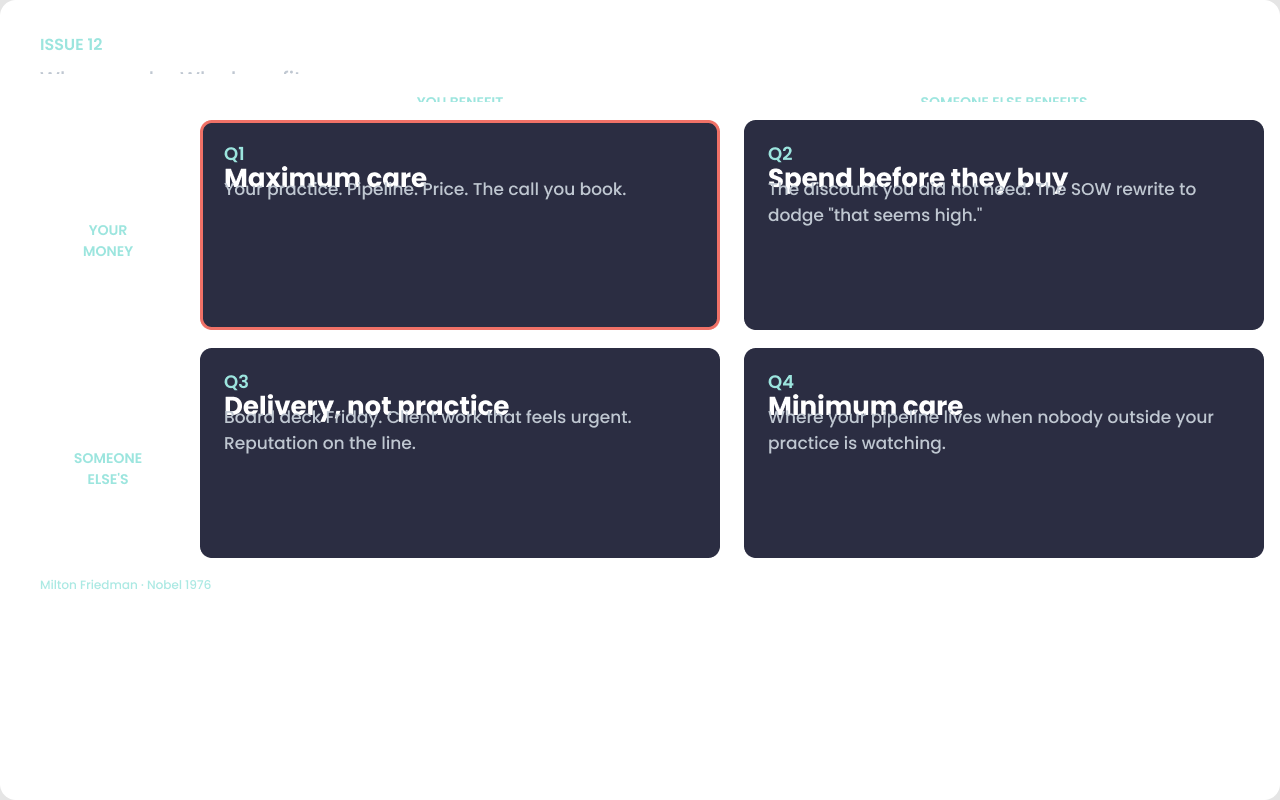
Draw a two-by-two. On one axis: your money or somebody else's. On the other: the benefit comes back to you or to somebody else. That gives you four ways to spend money, and the amount of care you bring to the spend changes completely depending on which box you are in.
Quadrant 1: Your money on yourself
This is your practice, not your client's company. Your pipeline. Your price. The follow-up to the hiring manager who said "let's talk in Q3." The scoping call with the prospect who already has budget. The hour you block to raise your rate before renewal season. Friedman said people spend their own money on themselves with maximum care. When a fractional treats their own business this way, they book the calls, name the price, and protect the margin.
Quadrant 2: Your money on someone else
You are still paying, but the benefit is theirs. This is the discount you did not have to offer to get the meeting. The extra research you do before the scoping call so they do not think you are overselling. The SOW you rewrite three times because you would rather spend your weekend than hear "that seems high," before they have committed a dollar. You are spending your margin and your calendar on their comfort. I call it the peacemaker reflex: you would rather eat the cost than risk an awkward conversation about money.
Quadrant 3: Someone else's money on you
The client pays you. You deliver. The board deck due Friday. The operating rhythm you run for their leadership team. The Slack thread at 9pm because their executive team presents Monday. You care about quality because your reputation rides on it. The cash is still theirs. Excellent fractionals live here all day. It feels like building your business. It is delivery, not practice.
Quadrant 4: Someone else's money on someone else
Minimum care. Vague tasks. Nobody watching. Big companies run whole departments here.
Here is the part that confuses people, and it is the part that got me. Your own practice can land in quadrant 4 even though it is your money and your outcome. Friedman would call that quadrant 1 on paper. But that is not how you treat it when you act like nobody is measuring you this week.
You treat your pipeline the way a middle manager treats a corporate initiative with no deadline and no boss asking for results on Monday. Minimum care. Someday. LinkedIn when things slow down. Liking a warm intro's post instead of calling. Reworking internal tooling while two qualified names sit in your CRM with no meeting booked. You are spending your time as if the benefit were diffuse and the accountability belonged to somebody else. That is quadrant 4 behavior on quadrant 1 work, and it is absurd, because it is your money and your revenue.
Once you see the grid, you stop blaming yourself for being lazy and start seeing a pattern.
You rebuild a client deck at midnight because their leadership team presents Monday. That is quadrant 3. Good delivery. Appropriate care on their dollar.
Your own pipeline sits in quadrant 4 for weeks. You know the names. You have not booked the calls. Nobody fires you for it. There is no executive team watching your revenue the way you watch theirs.

Now the part I would rather not write
I sat down with a notebook and wrote what I actually did in the last seven days. Not what I intended. What I did. Then I labeled each item with a quadrant number, one through four.
The two buyers. Ready to start. Top of my list. Next move on the screen next to their names. That is quadrant 1: my money, my outcome, the work that grows my practice. I gave them quadrant 4: minimum care, like a someday task I could get to when nothing else was pressing.
A live member issue on the platform. Real person, real problem. I dropped what I was doing and fixed it. Quadrant 3. Good reflex. I am not sorry I fixed it. I am sorry it won the morning I owed the two calls.
Finishing product work for clients. This one fooled me. It felt like quadrant 1 because it was important and my clients needed it. When I labeled it honestly, it was quadrant 3: delivery on their dollar, not practice on mine. Visible progress. No rejection risk. The two revenue calls sat exactly where they were.
Stabilizing the platform: warm-lead surfacing, Granola ingest, another pass on the referral engine, while two prospects ready to start sat on my home page for two weeks. I told myself the product had to be stable before I sold again. I said that out loud on a Freedom call the same week. Quadrant 4 on my pipeline, dressed up as builder work.
Five entries. Only one was honestly quadrant 1, and it was not the two names at the top of the board.
If you are running your practice on memory and last quarter's referral, start with the mirror audit on running your own practice. This article picks up where that leaves off: where your time actually went when the hard call was sitting right in front of you.
What the list is for, and what it cannot do
In Issue 11 of The Independent Chief I told you about the home page I built inside The Helm™. It reads your email, your calendar, and your conversations overnight, and every morning it puts a short list in front of you under Needs you today, with one next move beside each name. Reply owed outranks the message that arrived an hour ago. A dated promise outranks a warm introduction that went quiet. Same read for every member, mine included. Nobody is keeping that list by hand.
Friedman's grid is the label for why I still chose client work over the two names at the top of that list. The platform does not run the grid for you. It does not book the call. It does not stop you from treating quadrant-one pipeline work like quadrant-four work when nobody outside your practice is watching. What it does is make that neglect visible, the same class of problem I wrote about in when your pipeline is lying to you. Those two buyers were on the screen every morning with the move written next to their names. I looked past them anyway.
That is the limit, and I would rather say it out loud than sell you magic. The audit below is still yours to run. The calendar move is still yours to make. The list just removes the lie that you did not know who mattered.
Why the wrong quadrant feels so responsible
Researchers describe what people call imposter syndrome among high achievers as over-preparing and putting off the scary task, not because you need more capability, but because you are trying to feel less anxious. That matches one more platform pass when two names on my list needed calls. It matches the product polish I reach for when a phone call carries rejection risk. It matches the credential trap I still catch myself running: one more proof point, one more reason the buyer should not think I am overselling, one more full-time run before I am "ready" to sell on my own. There is no threshold at which "enough" arrives. The prerequisite can wait forever while you still feel responsible.
A founding client told me the same thing on a deal last year. He was probably over-compensating because he was afraid of a bad fit. He wanted to set expectations honestly, and almost talked himself out of a good opportunity. I told him what I needed to hear myself: you do not notice this while it is happening. You just over-explain, over-qualify, and hand the buyer reasons to hesitate. Good excuses. Still the wrong box for the work that actually grows your practice.
Friedman had another line people shorten to "no free lunch." The substitute task always charges you. It just never itemizes the receipt.
Your fifteen-minute Friedman audit
Take fifteen minutes this week. Write down three things you spent real time or money on in the last seven days. Label each with a quadrant number, one through four, using the definitions above.
Be honest. Client deliverables are often quadrant three, not one. Your pipeline is almost never quadrant one until you force it there.
Pick one practice item that belongs in quadrant one and move it with an appointment, not a task. Not "work on positioning." Call one person. Send one price. Book one hour for the sentence you wish people repeated at dinner.
If you want a demand lens before you label the quadrants, run where fractional executives actually get clients first. Pair it with how to build an independent consulting practice when the mirror is "great at delivery, thin on pipeline."
I am doing that with the two names still on my board. Label the box first. Deal with the feeling second. Willpower last, if it comes at all.
Freedom, for an independent, is not maximum hustle on client work. It is treating your practice with the same care you already give their business.
See if you fit: theretern.com/apply?utm_source=blog&utm_medium=organic&utm_campaign=independent-chief&utm_content=spend-their-money-better