The dangerous kind of procrastination does not look like scrolling. It looks like shipping. You do genuinely excellent work on the wrong thing, on purpose, for a month, and nobody including you can call it slacking. The tell is not that you were idle. The tell is that the thing you owed somebody is still owed while everything else in your week moved. Fix it by making the decision an appointment with an hour and a name on it, not a task.
This week is about two prospects who were ready to buy, and how I let both of them sit on my home page for two weeks without doing one thing about it.
I am going to tell you why that happened, why it is almost certainly happening to you right now, and what to do about it before Friday.
It was never a discipline problem
I have watched operators who can walk into a company that is losing money, find the real problem inside of a week, and fix it in ninety days. And sit on five warm names for a month without making one call.
I have never been able to make those two facts fit together if the problem is capability, which is how I know it is not capability.
Augustine wrote the best description of what it actually is, about sixteen hundred years ago.
If you have never read Confessions, read it. It is a long letter, written by a man in middle age, addressed to God, about his own younger self. He was a professor of rhetoric, which in that world meant a very well paid public speaker. Ambitious. Successful. And for roughly fifteen years intellectually convinced that he ought to change how he was living, and not doing it.
The line everybody remembers is a prayer he admits he actually prayed, out loud, during those years: "Give me chastity and continence, but not yet."
He is not confessing that he did not know what to do. He knew exactly what to do. He is not confessing that he did not want it, either. He wanted it, and he asked for it. What he is confessing is that he asked for it while quietly hoping it would not arrive too soon. He says so himself a few lines later: he was afraid of being heard too quickly, and cured too soon, of a disease he would rather have satisfied than cured.
That is the most honest thing anybody has written about putting something off, and he wrote it before there was Google Calendar to blame.
Sixteen centuries later the prayer is intact and only the subject has changed. Give me a pipeline I control, but not this afternoon. Give me the follow-up call, but not until I have cleaned up the deck one more time. Give me the referral ask, but let me wait for a natural moment, and the natural moment somehow never falls on a Tuesday.
What is really going on, and it is kinder than you think
Fuschia Sirois and Timothy Pychyl published a paper called "Procrastination and the Priority of Short-Term Mood Regulation." I want to explain their argument since it explains why we do this.
For decades the field treated putting things off as a time-management problem, or a self-control problem. Bad planning. Weak willpower. The fix was supposed to be a better system, a tighter calendar, more discipline.
The trouble is that the framing never explained what people actually do. If it were a planning problem, then the people who put things off would be bad at planning across the board, and they are not. If it were pure willpower, then the same person would fail at every hard thing, and they do not. The operator who avoids one follow-up call for a month will cheerfully do six hours of genuinely difficult client work in that same week.
That is not a shortage of willpower. That is a selection. And what you are selecting against is not difficulty. It is a feeling.
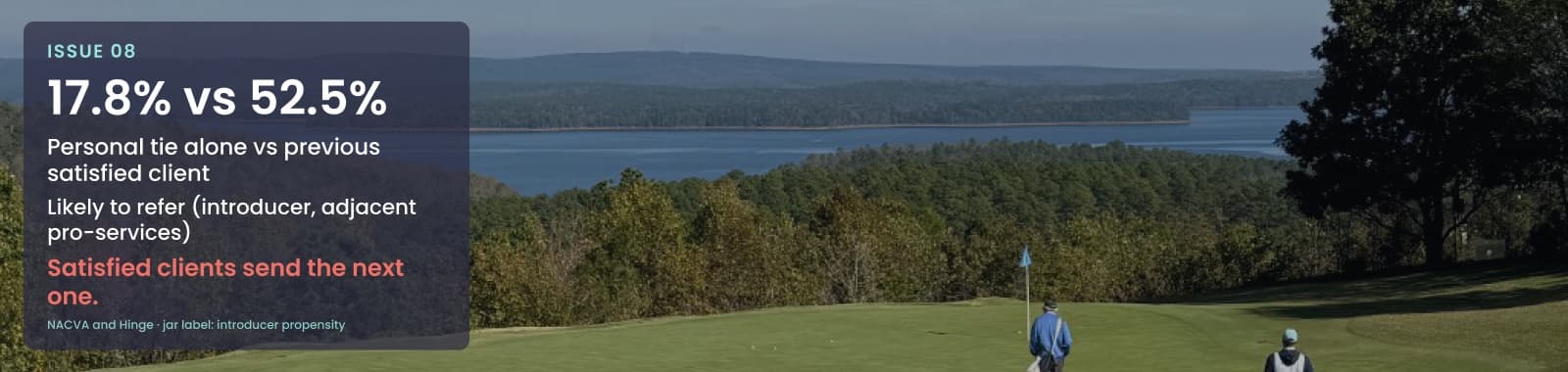
A task shows up carrying dread, or awkwardness, or the low hum of this could go badly. Your brain does what brains do, which is look for the fastest available way to stop feeling that. And there is always a fast way, because there is always another task sitting right next to it that carries no bad feeling at all. The inbox. The deck. A little more research. Sometimes I will even go play 9 holes.
Something that is genuinely work, which is exactly what makes it such a good escape, because nobody can accuse you of goofing off, least of all you.
And it works. That is the part worth sitting with. It is not a failed strategy. Twenty minutes later you feel better, measurably and immediately. I sure do.
The cost does not disappear. It gets moved. Sirois and Pychyl call the person who ends up paying it your future self, and that is the most useful idea in the paper. Your future self is the version of you who opens the laptop on Friday and finds the same call still unmade, plus five days of interest on it. He was not in the room when the deal was struck, did not get a vote, and has no way to appeal.
So look at your own list and ask what feeling each name is carrying. The friend who said that sounds great and then went quiet. The client who has stopped replying and you do not know why. The person you would have to ask for an introduction, which means saying out loud that you need something.
Every one of those carries the same small risk, and it is a specific one: a no, from somebody who likes you. Not rejection from a stranger, which costs almost nothing. Rejection from somebody whose opinion you actually care about.
Now the part that costs money
Three researchers, James Oldroyd, Kristina McElheran, and David Elkington, published a piece in Harvard Business Review looking at how fast companies responded to inbound enquiries. Not cold outreach. These were people who had already raised their hand and asked to be contacted.
They measured how long each firm took to attempt first contact, and then whether the firm ever managed to qualify that lead, which in plain English means reaching an actual human being who could make a decision and finding out whether there was anything real there or not.
Firms that tried to make contact within an hour were nearly 7x as likely to qualify the lead as firms that tried one hour later. One hour. Not one week, not one month. And the firms that waited a day or more were more than 60x less likely.
That study looked at companies with sales teams answering online enquiries, at a scale most of us will never touch. It is not about fractional practices, and it is not a promise about your income. It is directional, and it is something we can learn from.
What it does measure is the shape of the thing, and the shape carries over. An owed conversation does not sit still and wait while you get ready for it. It cools. The other person moves on, or solves it a different way, or quietly concludes you were not that interested.
Nothing dramatic happens, and that is exactly the problem with deferring. It never sends you a bill. It just gets a little more expensive every week and never mentions it.
I am not writing this from the outside
I built a platform for this work, The Helm™, and I run it on myself before anybody else does. Other independents run it too. Which means that when it is wrong, I know exactly whose fault it is.
The part that matters here is the home page, and it works the same way for everybody on the platform. Nobody is keeping a list by hand, mine included. It reads your email, your calendar, and your conversations overnight, and every morning it puts a short list of people in front of you, already in the order you should deal with them.
Not everything, and not the newest thing, which is what almost every tool shows you when nobody tells it otherwise. The order comes from what actually moves a practice forward rather than from what happened most recently. Years of doing this work, and then watching which conversations turned into money and which ones quietly died, is what taught the thing how to rank. That sentence makes it sound tidy. It was not. Most of what went into it I learned by being confidently wrong about who mattered.
So a proposal somebody is sitting on outranks a message that landed an hour ago. A client who has gone quiet outranks a fresh introduction. Loud and important are not the same thing, and a list sorted by time confuses them every single morning.
I also just turned on a live LinkedIn connection inside The Helm™, which my clients have been asking me for. Two things happen. Your LinkedIn messages start counting, so the ranking stops being wrong about who has actually gone quiet. And it goes through everybody you are already connected to and finds the ones who belong in your book and are not in it. For one client that surfaced 105 people who were already warm, meaning he had messaged with them himself at some point.
It reads what is already yours, and only what is already yours. It does not send anything as you, and it never will, because that account carries your name and your reputation, and those are not mine to spend.
Now the part I would rather not write
For two weeks there have been two people sitting on my home page that I have not reached out to.
Not because the ranking is wrong. It is right, and I know it is right. Not because I do not know what to do, either, because the move is written on the screen next to their names.
In those same two weeks, I built and shipped the LinkedIn release.
That was real work. It was hard, it took the whole two weeks, it is good, and my clients had been asking for it. I am proud of it. Nobody could look at those two weeks and tell me I was slacking, and that is the entire problem, because it means I could not tell myself either.
It was not procrastination that looked like scrolling. It was procrastination that looked like shipping. I got two weeks of visible progress, the satisfaction of finishing something difficult, and the total absence of the one feeling I was avoiding, which was picking up the phone to two people who might say no. Meanwhile the only two conversations that could have moved revenue this month sat exactly where they were.
I built a system to tell me who to call, and then I built something else instead of calling them.
In case you are wondering whether it flagged those two for me the whole time, it did. Every morning. Politely. There is no one to blame here but me.
I am telling you this because I think it is the most common version among people like us, and it never gets diagnosed. You are not going to catch yourself watching television when you should be selling. You are going to catch yourself doing excellent work on the wrong thing, on purpose, for a month.
The tell is not that you were idle. The tell is that the thing you owed somebody is still owed, and everything else in the week moved.
So ask the harder question this week. Not what did I get done. Ask what did I get done instead, and what did it cost me.
Stop treating a decision as a task
A task is something you intend. Tasks slide, and nobody has ever been late for a task, because a task has no time on it and no person waiting at the other end.
An appointment is something you keep. I would guess you have never once no-showed a client, and that is not because you have more discipline on client days. It is because the commitment had an hour on it and a name attached to it.
So give this one the same shape.
Take one name. Write the next move in verbs, not in intentions: call him, ask her for the introduction, send the note you drafted and never sent.
Underneath it, write down the feeling you have been avoiding. Not the excuse, the feeling. It is almost always one of a short list, and none of them are impressive. He might say no. She has probably hired somebody else by now. I will look like I need the work. I do not want to hear that the budget is gone. I will have to admit I let this sit too long.
For me it was simpler and worse than any of those. I did not want to admit that both of these people might say no, and I did not want to face the rejection if they did. So rather than get an answer and move on to other people, I let them take up space on my home page while I built the LinkedIn product.
Naming it takes most of the air out of it. Nobody has ever looked at three honest words on a page and still thought the call was the hard part.
Then put the move on your calendar with a real hour, this week, with that person's name in the title, exactly the way you would book it if a client had asked you for it.
Then keep the appointment. That is the whole thing.
Freedom, for an independent, is a pipeline you control, and control does not start with more names. It starts with the distance between knowing what you owe somebody and actually doing it getting shorter.
I am going to go keep mine.