Friendship opens the door. It is not a growth system by itself. Find a pain they will pay to stop, stay curious, aim for a short paid pilot, and remember the compounding number: previous clients refer at roughly three times the rate of a personal tie alone.
Golf buddies. Presidents of real companies. Friends who would take your call at nine at night. And somehow they are still not clients.
Casual rounds. "That sounds great." Nothing happens.
I hear that same question from a lot of independents: how do you convert a friendship into a business relationship without wrecking the friendship? What are the techniques to move that relationship into a short paid engagement: give me a chance to prove myself.
Every week on our Crew call, I put someone on the hot seat for that kind of question. One person brings a real pipeline problem. We dig. The rest of the room shares their experiences: what worked, what did not. We follow the Gestalt rule. In plain English, that means each person speaks from their own lived experience. Nobody lectures the hot seat from theory. Nobody "fixes" them with advice. The learning comes from the whole room's pattern, not from one clever answer.
This week's hot seat was Keith. His question landed almost word for word as the one above. So I made it this week's Independent Chief topic, and this longer cut.
Friendship is not a growth system
Here is the part we should not soft-pedal. We run in circles with the same people because the world is small. Many of you have friends who could be clients. That is not a side topic. At the start of a practice, that circle is almost the whole plan.
What friendship alone is not: a growth system by itself.
The Doobie Brothers put the soft vision on What a Fool Believes, Yacht Rock scripture with Michael McDonald on the lead: "What a fool believes he sees, no wise man has the power to reason away." The friend zone runs on that same soft vision. You keep seeing a client in someone who has never shown you a pain they will pay to stop.
Be curious, not judgmental
Ted Lasso walks into a crowded pub where people have already decided he is a joke. He picks up the darts. Then he drops the line that should run every sales conversation you will ever have: be curious, not judgmental.
I keep seeing this on calls. That is the posture. Now the method.
The destination most independents want and almost never say out loud is a short paid engagement with someone they already trust. Not forever. Not awkward. A chance to prove the work, then decide together whether to continue. Call that a pilot if you want. The hard part is getting there without sounding like you are selling your friend.
Dennis had been in the same spot on that Crew call. Friends high up in companies. Incredible networks. Reach-outs that landed as "I did not know you were looking for work." The work does not sell itself if they cannot picture what they need you for.
That cold-sounding reach-out is the trap a lot of my clients walked into before they found me. They did not know where to start, so they went cold. What they never realized: the warmer list was already sitting in front of them.
One client found 105 leads inside his own LinkedIn. Not strangers. People he had already messaged with. You can try stitching that together yourself in your favorite AI model, but it takes real effort. The Helm™ does the boring part on purpose: it dials in who you actually help, in which companies, with which problems, then refines that picture over time as it reads your emails and your calendar. The list gets smarter. More on how that works in a follow-on newsletter. The point for this piece is simpler. Before you invent a cold approach, look at who already knows your name.
Here is what I told Keith and Dennis. Not theory. What has actually worked when I have been in that seat.
Step one: pain they will pay to stop
I keep seeing this on calls. People pay a lot of money to make something painful go away. A friendship only turns into paid work when that pain has teeth.
Take Keith's world for a second. Private equity. A chief executive officer (CEO) promised his board $10 million-plus of cost removal from their most recent acquisition. However, neither company (his nor the acquired) has the expertise in house to remove those costs within the projected timeline. That gap is Keith's specialty.
Here is the catch. If nobody gets hurt when they miss that number, it is not pain. It is theater.
So I ask a simpler question. Where does that commitment sit against the CEO's real performance objectives? If it is in the top three, they still cannot hit it, and a board meeting is coming up, then you have something real: pain plus a clock. If the same problem has sat around for years and they never brought anyone in to fix it, it was never important enough to pay to make stop. Offering a pilot before you know which of those you are in is just a friend with a product. Both of you can feel it.
People really only care about their own problems. Even friends. There is that old golf joke: a guy plays eighteen with his newly divorced buddy. Comes home. His wife asks how the friend is doing. She wants dirt. She is still friends with the ex. He has no idea. He never asked. They talked about nothing that mattered. That is the friend zone in a picture. No pain. No path to paid work.
I keep seeing this on calls. So stop the free problem-solving. Start a diagnostic conversation.
Step two: ask, do not pitch
My first client was a friend with a great company that was over his head: a fast-growing tech startup in Austin. I did not pitch a pilot. I started by asking about his business and how things were going. Then I got curious and kept asking questions, so he started sharing. What surfaced: he was growing faster than the cash coming in, and he was floating the company with his own money. Millions. That is when I asked: how are you fixing the problem? Not "I will fix it." Then: how much is this costing you personally? That is when he lit up and asked if I could help. I never offered a package. Same Migration Method™ I teach for cold discovery. The only difference is you already know them.
Step three: take selling off the table
When selling energy shows up, friendship dies. So carry this in your back pocket:
"I do not even know if I can help you."
Even when someone says they are interested. All you are doing is getting curious about what they are running. Then lead a question cycle until they tell you whether anything is actually broken. Keith said it back better than I did: I am not sure I can help you. What is killing you right now?
It disarms everybody. It keeps you in curiosity. It lets them ask for the next step.
Step four: press the real priority
When they start leaning in, ask whether this is one of the three things the board is measuring them on. If it is not a top issue, walk them out of hiring you. Be the first person to tell him that this project is not important enough for him to fix it. Let him tell you otherwise. If he does not, you just bought yourself referral credibility.
Here is the posture that makes that question land. Talk like an owner, not like an employee or a consultant protecting a seat.
I have a client who is advising a fast-growing company. The CEO is also the largest investor, so she is funding the growth with her own money.
That is where growth gets weird, and Doug Tatum spelled it out years ago in No Man's Land. Rapid-growth companies run into money trouble because growth itself creates the need for capital. Costs step up before revenue catches up: inventory, payroll, the float that has to leave the bank so the next order can ship. You can show a profit on the books and still have more cash going out than coming in. Ship a big order this month and the income statement can look fine. The bank account does not, because inventory, vendor deposits, and freight left weeks ago and the customer invoice is still open. Double the orders and you double how underwater you are until the cash arrives. Faster growth, prettier P&L, emptier bank account. That is not exotic. That is the cost of climbing.
I told my client to talk to her as an owner. Growth matters. The cash drain matters just as much. That is how you earn peer trust instead of sounding like someone guarding billable hours. Walking them out of a non-priority job is the same honesty: owner to owner.
That sounds insane. It does two things. Your friend trusts you, because you cared about them more than the deal. And when a colleague of theirs is actually dying under a real problem, you are the person they send: the one operator willing to talk himself out of a job.
If it is a top issue, they will pay to make it go away. That is when a short paid engagement makes sense. If it is not, it sits on an initiative sheet and gets kicked. You do not want to be the friend chasing a land grab.
When the pain is real, stay with what they already said matters: the board, the top three objectives, the date that will not move. Employee posture waits to be invited. Owner posture stays with the problem until the other person decides whether they want help.
The number that compounds
The friend-zone conversation is real. The number that compounds a practice is a satisfied client.
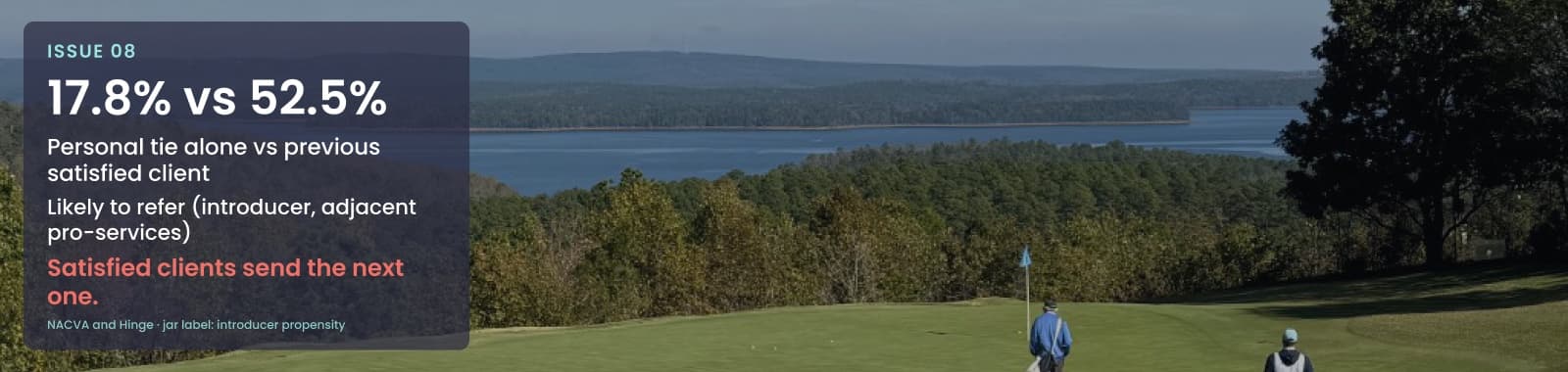
In adjacent professional-services research (NACVA and Hinge, introducer-style relationships), people with only a personal relationship were about 17.8% likely to refer. Previous clients were about 52.5%. Jar label: introducer and adjacent pro-services, not "friend as buyer." I keep seeing this on calls. The point still holds. Warm circles are not Harbor.
Harbor is client health: deliver so well that the people who already paid become the engine.
Friendship opens doors. Satisfied clients send the next one. Cold LinkedIn theater fills a calendar. Warm history, Ideal Customer Profile clarity, and a diagnostic conversation fill a practice.
Freedom, for an independent, is a pipeline you control. Income that stops being a rollercoaster. Friendships that can become work without becoming awkward theater. And a growing set of delighted clients who send the next one.
Do one thing this week
Pick one warm contact. Next time you see them, float questions. How are you fixing it. What is it costing you personally. Is this a top-three board measure. Rehearse the line: I do not even know if I can help you. Then listen. Do not open with a pilot offer. Earn the right to talk about paid work after the cost is real.
If you want a straight read on where your practice stands, including whether Authority (pipeline) is the weak dial, the free check takes a few minutes and shows you the weakest area first: Where does your practice stand? Take the free check
Become known as the person who asks a lot of questions. Soften it with "I do not even know if I can help you." That disarms everybody.