I have read exactly one golf instruction book in my life.
It is called Swing Easy, Hit Hard. Julius Boros wrote it in 1965. It is thin, it is simple, and it did more for my game than every lesson, every range session, and every tip I have ever ignored.
After I read it, I became a scratch golfer. Today I play to a +2. I am not telling you that to impress you. I am telling you because it is the cleanest proof I have that the method works, and it is the same method that keeps a fractional practice from living on feast or famine.
Here is the part that took me years to understand. Boros looked effortless. The swing was smooth, unhurried, almost lazy. It was also completely calculated. Nothing about it was an accident.
From accountant to champion: the system behind the "natural"
Before he was Boros the champion, he was Boros the accountant. He kept the books for a trucking company in Hartford, Connecticut, and did the bookkeeping at Southern Pines Country Club. He did not turn professional until late 1949, when he was twenty-nine, pushing thirty. That is an age when most players have already decided who they are going to be.
Three years later he won the U.S. Open. 1952, Northwood Club in Dallas, in heat near ninety-eight degrees. He finished at 281, four strokes clear of Ed "Porky" Oliver, and interrupted Ben Hogan's bid for a third straight U.S. Open. The accountant beat the field, and the field included a fading legend.
He won the U.S. Open again in 1963, at forty-three. In 1968, at forty-eight, he won the PGA Championship: the oldest major champion in history for more than half a century, until Phil Mickelson in 2021. Eighteen PGA Tour wins. Three majors. World Golf Hall of Fame. They called him "Moose."
The world called him a natural.
Herbert Warren Wind wrote in The New Yorker: "Poker-faced, laconic, a bit on the dour side, he is an efficient rather than an arresting golfer." Tony Lema said Boros "is all hands and wrists, like a man dusting the furniture." Boros never took a practice swing. He walked up, cigarette in hand, and hit it. Everyone assumed it came easy.
It did not. It was built.
Calm under pressure is an operating system, not a personality
Listen to Boros himself, in GOLF Magazine, December 1967: "I am amused when I hear people say that I play completely relaxed and unconcerned. Let me say right here that I feel the pressure just like everyone else. Possibly I manage to conceal it more than most of the others. But it's there. But the greater the pressure the more I attempt to slow my tempo so that I won't rush or jump at a shot."
That is not a personality. That is a system. He decided on his club while walking to the ball. He refused practice swings because they interfered with his "pre-swing pattern." He kept moving so he never froze over the shot. The calm was engineered. The title of the book was a method, not a mood. Swing easy, hit hard.
Here is my confession, part two. I studied accounting and finance in college. Maybe partly because I wanted to follow in Boros's footsteps. I will not build a tidy origin story out of it, because the honest truth is I am not entirely sure. But the pull was there.
And I did follow him. Just not onto a golf course.
Boros left the ledgers to build a career on a system. I left corporate to create and follow an operating system for independent executives. Same move, different arena. He traded bookkeeping for a repeatable swing. I traded a title for a repeatable rhythm. I pioneered the fractional executive movement over fifteen years ago and founded Chief Outsiders, and the whole thing rests on one idea: the calm belongs to the person who built the system.
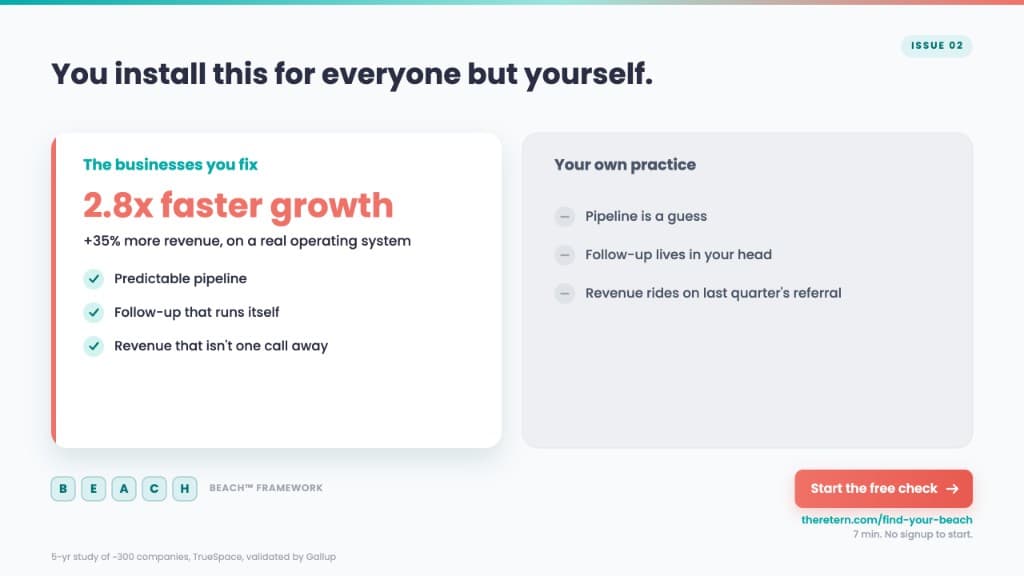
If you already know you run a system for every client and none for yourself, start with the mirror audit on your own practice. This piece is the next layer: how that system manufactures what other people call luck.
Why lucky fractional executives notice the next opportunity
Richard Wiseman, a psychologist at the University of Hertfordshire, spent ten years studying 400 volunteers, ages 18 to 84, and published the work in Skeptical Inquirer in 2003. He wanted to know why some people are lucky and some are not.
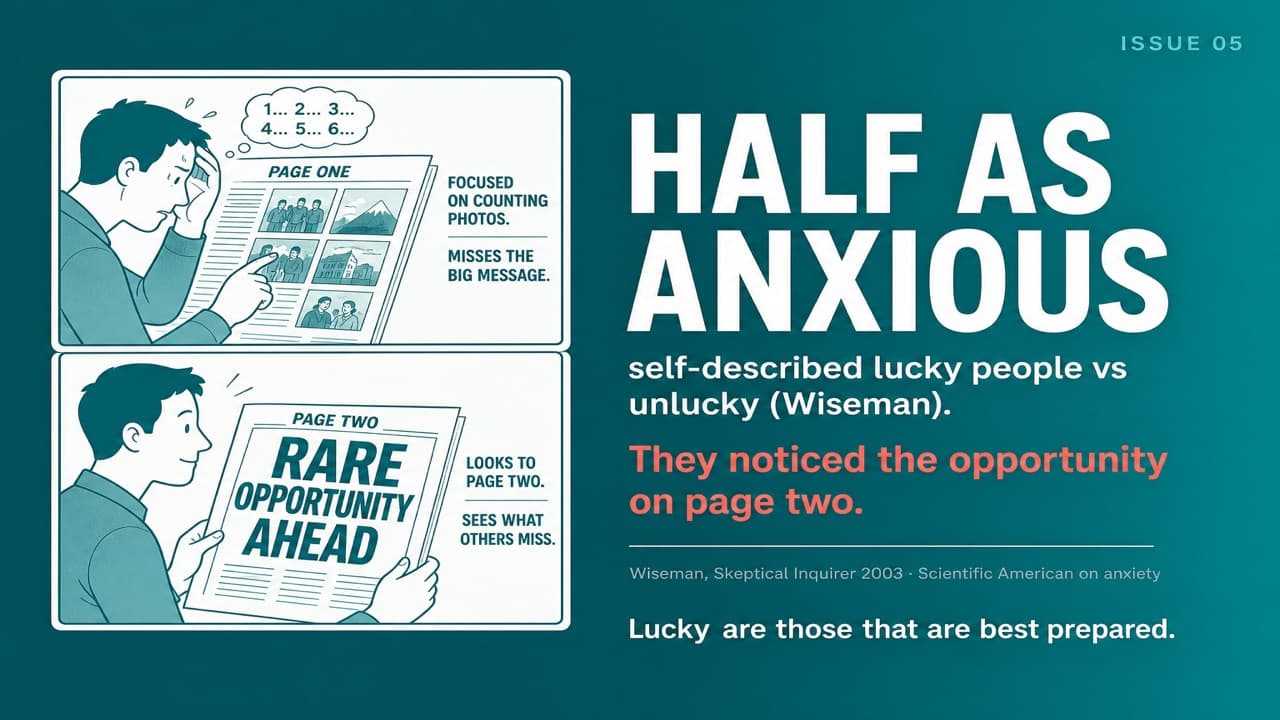
He gave them a newspaper and asked them to count the photographs. The people who described themselves as unlucky took about two minutes. The people who described themselves as lucky took seconds. Why? Because page two carried a message in type more than two inches high: "Stop counting. There are 43 photographs in this newspaper." A second message, half a page, read "Stop counting and tell the experimenter you have seen this and win $250." I keep seeing this on calls. The lucky people saw both. The unlucky people counted right past them.
As Scientific American put it, "the lucky ones were half as anxious as the unlucky ones." Relaxed people notice things. They catch the opportunity sitting on page two.
Wiseman also followed 700 people who intended to buy lottery tickets. The ones who called themselves lucky were twice as confident they would win. They did not win any more money. The luck was never in the draw. It was in the noticing.
Boros engineered exactly the state Wiseman measured. Half as anxious, on purpose. He proved that low anxiety can be a built system, not a personality gift. I learned that system from a book as a golfer, and it is why I play to a +2. Then I rebuilt the same principle as a business operating system. The fractional executive who wins the good quarter is running the same play.
Weekly pipeline rhythm: the luck machine for your practice
I keep seeing this on calls. Not your network alone. Your rhythm.
I keep seeing this on calls. Run a weekly pipeline review. Every week, not when things get slow.
Run the Referral Method™ on a small Partner Circle™. Give first, make sure they can describe you, close the loop when an intro lands. Same rhythm, every week, built into the calendar.
Hold a weekly operating rhythm that you do not skip when you get busy or scared.
A network without a rhythm is a pile of contacts you hope will remember you. A system is the set of actions that make sure the contacts turn into conversations and the conversations turn into work. When the rhythm finally produces a lucky quarter, the people who never saw the reps will call you a natural. Let them.
(If your "pipeline" is really last quarter's referral and a prayer, your pipeline is probably lying to you. If someone sold you the idea that a pile of connections is a strategy, read the network lie.)
Belief does not come first. The system produces it. Boros left the ledgers believing he belonged on tour, and he won the national championship within three years. Do not mistake the order of operations. You trust the rhythm, the trust becomes belief, and the belief holds up under pressure because it is backed by reps.
I keep seeing this on calls. You will not think your way into belonging. You build the rhythm, and the belief follows the reps.
Do this for your fractional practice this week
Block sixty minutes. Take one page. Write three items.
- Your weekly pipeline review.
- Your Partner Circle move this week (give first, or close a loop).
- One action that a person who already belongs at the table would take this week.
Call the third one the Boros move. Take it before you feel ready, because Boros never took a practice swing either. Readiness is not a feeling you wait for. It is a rhythm you already run.
Late in his life, someone asked Julius Boros about retirement. He said, "What would I retire to? I already fish and play golf for a living." That is what a practice built right looks like from the inside. Not a grind you are trying to escape. A rhythm you would not trade.
I keep seeing this on calls. The world will keep calling it luck. You will know better.
Lucky are those that are best prepared.
If you want a straight read on whether your practice is running on rhythm or on hope, the free check takes a few minutes and shows you the weakest area first: Where does your fractional practice stand?