

You can be excellent at the work and still wake up wondering where the next client comes from. That is not a character flaw. That is a pipeline that still runs on luck, often made worse by one word people keep mangling: interim.
They say interim when they mean fractional. They say fractional when they mean a contractor with a fancy title. Then they wonder why the phone does not ring.
If you are searching for interim vs fractional executive, you are not being pedantic. You are trying to stop inheriting the wrong hours, the wrong scope, and the wrong exit.
Interim executive vs fractional executive: the clean split
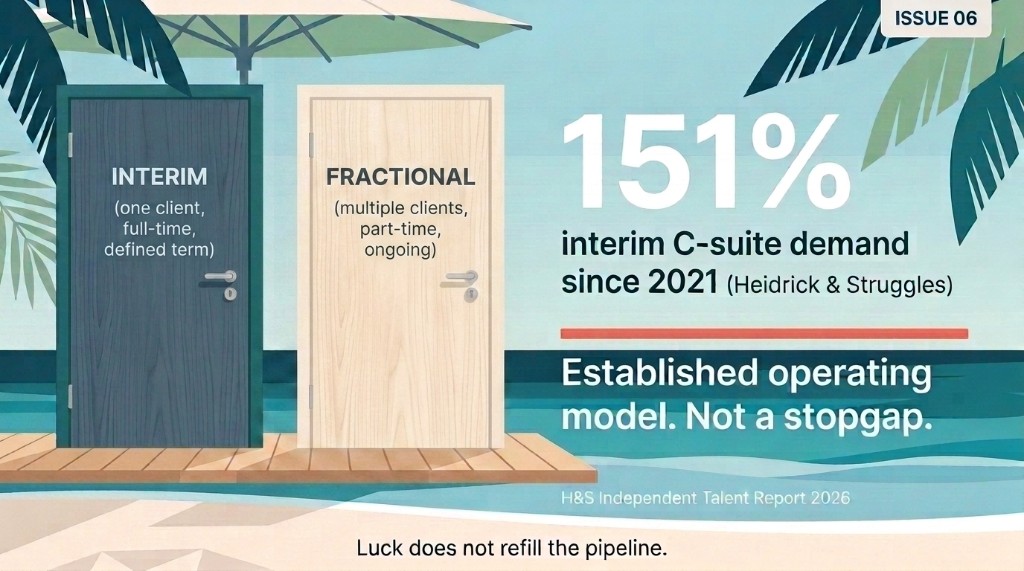
Interim is one client, full-time, for a defined stretch, while a permanent seat gets filled. Often six to eighteen months. Bridge work.
Fractional is multiple clients, part-time, ongoing. Leadership that stays.
| Interim executive | Fractional executive | |
|---|---|---|
| Clients | One at a time | Multiple at once |
| Time | Full-time | Part-time |
| Duration | Defined term (often 6 to 18 months) | Ongoing relationship |
| Job | Fill a full-time gap temporarily | Lead without living in one seat forever |
| Exit | Usually when a permanent hire lands | Continues or evolves with the company |
Consultants advise. Contractors execute. Fractional executives lead. Interim fills a full-time gap temporarily. If you blur those, you pitch the wrong offer to the wrong buyer's calendar.
Four labels people mash together:
- Consultant advises and recommends. Ownership of the outcome usually stays with the client's team.
- Contractor executes a scoped deliverable. Often project-bound, not a seat at the leadership table.
- Interim executive sits in a full-time seat for a defined stretch while the company finds or prepares a permanent hire.
- Fractional executive owns a leadership seat part-time across multiple clients, on an ongoing basis.
I keep seeing this on calls. Same person can do more than one of those in a career. The mistake is selling Tuesday's container with Friday's label.
For the baseline model of fractional work itself, start with What Is a Fractional Executive?. If your card still says "consultant" when you sell ownership, read Fractional Executive vs Consultant next.
Clients hire the pain conversation first
Clients do not hire a title first. They hire the person who can name their pain out loud, then fix it.
The title, interim or fractional or contractor, matters later: when they are ready to buy the shape of the engagement. Those are two different jobs at two different times.
Get the pain right and the conversation opens. Get the container wrong and you inherit the wrong hours, the wrong scope, and the wrong exit. Clarity is kindness. Smile-and-take-the-wrong-label is how excellent operators burn a quarter.
What the establishment finally said out loud
Heidrick & Struggles, a top executive search firm, published their 2026 High-End Independent Talent Report. Demand for interim C-suite leaders is up 151% since 2021. They describe flexible leadership as an established operating model, not a stopgap.
That is not chest-thumping. That is the search industry catching up to a movement I pioneered over fifteen years ago when I founded Chief Outsiders and helped create the fractional executive category.
What that number is not: a promise that your inbox fills itself because someone else's report went up 151%. The figure is about interim demand in a weighted enterprise and large mid-market set. It is not your pipeline. It is not The ReTern's pipeline. Anyone who sells it as "about you" is doing marketing, not teaching.
Interim is often the on-ramp
Sue Mysko has been writing about an interim surge. Her useful thesis, as discourse and not as a Heidrick measurement: companies often test outside leadership with an interim engagement first. After one good run, resistance to flexible senior talent tends to fall. Fractional conversations often show up twelve to twenty-four months later.
I know the shape from the other side of the table. On one of my first engagements for Chief Outsiders, I did not want to be full time, and I did not want to be there long term. So I asked for a ninety day contract first, to see if we were compatible. After a few of those, I realized the model was ideal for both the client and for me. That is how fractional landed as a practice I could run: not as a fancy title, as a way to lead without living inside one seat forever.
I keep seeing this on calls. Interim is the on-ramp. Fractional is the ongoing form of that same buy.
Why the mixup still costs you clients
When you answer "interim" to a buyer who needs ongoing part-time leadership, you look expensive, short-term, and hard to schedule around a permanent search. When you answer "fractional" to a buyer who needs a full-time bridge, you look part-time for a full-time hole.
Same talent. Wrong container. Deal dies, or worse, you take it and resent the calendar for six months.
A quick filter before you answer "yes" on a call:
- Do they need one full-time hole filled until a hire lands? That is interim language.
- Do they need ongoing leadership without a full-time headcount? That is fractional language.
- Are they asking for advice and a deck? That is consulting language, even if they say "fractional" because it is fashionable.
- Are they asking for a scoped build with a hard end date and no seat? That is contractor language.
If you cannot tell which of those four they mean after fifteen minutes, do not invent a hybrid. Ask out loud: "Are you filling a full-time gap for a season, or buying ongoing leadership a few days a week?" The buyer who gets offended by that question was never going to be a clean engagement.
Category creators do not wait for the old town to rename the job. Willie Nelson left Nashville when the town said his voice was wrong. He stopped auditioning for people who wanted him to sound like everybody else. Name the work. Then run it.
If your next client still depends on who remembers you this quarter, your pipeline is probably lying to you. A label fix without a rhythm is still hope. The operators who manufacture luck with a weekly system do not treat market headlines as a substitute for preparation. For first-client timing myths, see How Long to Land Your First Fractional Client.
Do one thing this week
Open your network. List five people at companies that just hired, or are about to hire, their first interim executive. Not five random LinkedIn likes. Five buyers who are trying outside leadership for the first time. Those companies are often one to two years from needing the ongoing form.
If you do not know those buyers yet, ask a peer who already trusts your work and can introduce you. Then write one sentence you could send that names what you lead, not what you temp.
I keep seeing this on calls. That is preparation. Luck is what other people will call it later.
Freedom, for an independent, is a pipeline you control. Income that stops being a rollercoaster. A practice that does not live only in your head. You get there by turning the relationships you already have into the next client, on a rhythm, not by waiting for the market to feel generous.
If you want a straight read on where your practice stands, including whether Authority (pipeline) is the weak dial, the free check takes a few minutes and shows you the weakest area first: Where does your practice stand? Take the free check.
FAQ: interim vs fractional executive
Is an interim executive the same as a fractional executive?
No. An interim executive is usually one client, full-time, for a defined term. A fractional executive is usually multiple clients, part-time, ongoing. Same leadership skill can show up in both containers. The buyer's calendar and exit path are different.
Which should I put on my LinkedIn headline?
Lead with the pain you solve and the seat you own (CMO, CFO, COO, CHRO). Then name the container you actually sell. If you sell ongoing part-time leadership, say fractional. If you sell full-time bridge work, say interim. Do not use both as synonyms.
Does the Heidrick 151% mean my pipeline will fill?
No. It means interim C-suite demand rose sharply in their studied set since 2021, and they call flexible leadership an established operating model. Useful market context. Not a personal forecast.
Can interim work lead to fractional work?
Often yes, as a pattern in the market: companies test outside leadership with an interim seat, then become more open to ongoing flexible leadership later. That lag is discourse and lived practice, not a guarantee for any one engagement. Treat every interim run as a proof of fit and a chance to earn the ongoing conversation, not as a permanent identity.
What should I say in one sentence?
Write a sentence that names the seat and the container. Example: "I am a fractional CMO for growth-stage companies that need senior marketing leadership without a full-time hire." Or: "I take interim CFO seats when a finance leader exits and the company needs a full-time bridge." If your sentence could describe both, it is still fuzzy.