How do fractional executives find their first client? Start with trusted relationships and a specific business problem. The ReTern serves independent fractional executives building their own practice, not companies shopping for an executive. Define responsibility and authority before proposing fractional executive work. Keep your referral pipeline active during delivery; a contact list is not a follow-up plan.
Next: Get 30 minutes with me.

Find your first fractional executive client by starting with people who know your work, naming a business problem you can own, and asking for a conversation about that problem. Use the conversation to establish responsibility, decision authority, and a clear scope—not to give away the diagnosis. Keep relationship work on your calendar after delivery starts, so finding work does not disappear behind doing it.
- How do fractional executives find their first client? Start with trusted relationships and a specific business problem.
- The ReTern serves independent fractional executives building their own practice, not companies shopping for an executive.
- Define responsibility and authority before proposing fractional executive work.
- Keep your referral pipeline active during delivery; a contact list is not a follow-up plan.
Why this matters
You do not need to announce a smaller version of your corporate job. You need to explain what you will take responsibility for inside someone else’s business. A title introduces your background; it does not define the work a buyer needs done.
The ReTern is a membership platform and practice-management toolset for independent fractional executives and consultants building their own practice. That distinction matters here: this is about operating your business, not helping a company select an executive.
Already serving clients? Apply the same discipline to your next opening. Protecting relationships during delivery belongs in your operating routine, not in the gap after an engagement ends.
How do fractional executives find their first client?
Start with relevant relationships, establish a problem worth owning, and agree on a defined engagement. Work through that sequence before spending your attention on a broad announcement or an elaborate proposal.
Define the work
Write down the business situation you want to enter, the responsibility you will take, and the decisions you need authority to make. Keep these separate from your biography. Experience explains why someone should listen; scope explains what they would be engaging you to do.
Describe work a buyer can recognize. For example, name the operating problem you would investigate and the leadership responsibility you would discuss. Treat that as a starting point for discovery, not a claim that you already know what their business needs.
Identify relevant relationships
Review former colleagues, clients, peers, and professional contacts. Prioritize people who have seen you work or understand the situation you want to address. Familiarity alone is not the reason to reach out; relevance is.
Beside each name, record the connection to your proposed work. If you cannot explain why that person belongs in the conversation, keep looking rather than sending a generic availability announcement.
Open a specific conversation
Explain the kind of work you are taking on and why you are contacting that person. Ask whether the problem exists in their business or whether they know someone responsible for it. Give them something recognizable to respond to.
Avoid asking a contact to market your entire career. A clear description of the situation you address gives a potential referrer language they can use without translating your résumé.
Establish the problem
In the conversation, ask what is happening, what it prevents, and who owns the decision to change it. Ask what the business has already tried. Let the buyer explain the consequences before you offer an approach.
Do not treat a pleasant conversation as an engagement. Establish whether there is a real responsibility to discuss and whether the people involved can authorize the work.
Define the engagement
Put the proposed responsibility, boundaries, decision rights, and working arrangements in writing. Separate what you will own from what remains with the internal team. State what requires additional agreement.
Write the proposal after you understand the assignment. A polished document does not replace agreement about the problem, the authority, or the buyer’s next decision.
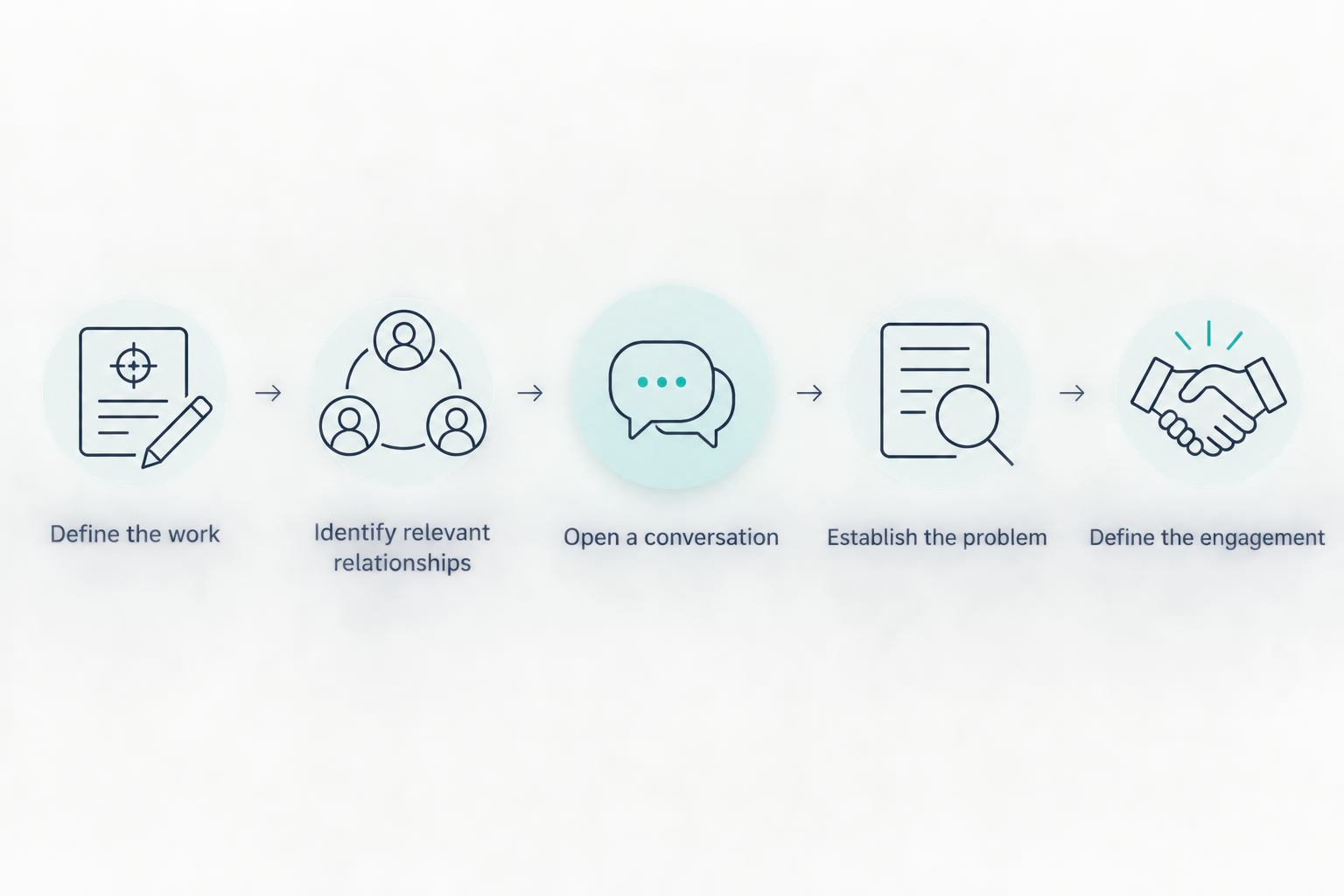
Establish the problem before defining the engagement.
Which relationships should you approach first?
Use the route that matches your actual relationship to the business problem. Do not send the same request to someone who has worked beside you and someone who has never heard of you.
| Route | Best for | Useful starting point | Limit to respect |
|---|---|---|---|
| Former colleagues | Reconnecting around work they understand | Explain the responsibility you now take on independently | Shared history does not establish a current need |
| Referral partners | Reaching a relevant buyer through an introduction | Describe the situation that makes an introduction useful | Your contact cannot make the buyer’s decision |
| Direct outreach | Contacting a specific business with a relevant question | Explain the observable reason for the conversation | Do not present an assumption as a diagnosis |
| Peer relationships | Maintaining professional context and exchanging relevant introductions | Be clear about your scope and the work you do not take | A peer conversation is not automatically a sales opportunity |
Start with the people whose context lets you be specific. If a former colleague understands your work but has no relevant connection, leave the conversation there. Do not turn goodwill into an obligation to produce an introduction.
For direct outreach, distinguish observation from interpretation. You can ask about an announced business change. You cannot claim that the change has created an internal problem you have not established.
What should you say when asking for an introduction?
Give your contact a short description they can pass along accurately. Include the kind of business situation you address, the responsibility you take, and the person who would recognize the need. Leave out the career summary.
Build the request around these elements:
- Situation: Describe the business condition that makes your work relevant.
- Responsibility: Explain what you would discuss taking ownership of.
- Connection: State why this contact came to mind.
- Permission: Let the contact decide whether an introduction makes sense.
Keep confidential information out of the request. Describe your work without exposing a former employer’s internal problems or another client’s plans. An introduction should not require someone to forward sensitive context.
After an introduction, take responsibility for the next step. Thank the person who connected you, arrange the conversation directly, and avoid making the referrer manage the process. Share an appropriate update without reporting private details.
What belongs in the first buyer conversation?
Your job is to understand the assignment, not perform the engagement before it exists. Ask questions that reveal the business problem and the buyer’s ability to act on it. Take notes in the buyer’s language rather than replacing their explanation with your preferred framework.
Cover the following areas:
- The problem: What is happening that needs attention?
- The consequence: What work or decision is being held up?
- The owner: Who is responsible for changing the situation?
- The authority: Which decisions would a fractional executive control?
- The decision: What must happen before an engagement can be agreed?
You can explain how you would approach understanding the work without handing over a business-specific action plan. Draw that boundary plainly. Detailed diagnosis is work, not proof that you deserve a later conversation.
End by agreeing on the next action and its owner. That action might be another discussion with a decision-maker or clarification of scope. If there is no agreed next action, record the conversation as unresolved—not as work you expect to receive.
Why the path to a first client varies
Use these factors to decide what your next conversation needs to establish. Do not treat another independent executive’s route as an instruction to copy their audience, message, or engagement shape.
- Existing trust: A contact who has seen your work starts with different context from a stranger. Adjust how much background you provide.
- Problem clarity: A buyer who can name the responsibility needs a different discussion from someone still describing symptoms.
- Decision authority: Establish who can approve the engagement and who must be involved before you write a proposal.
- Engagement boundaries: Separate executive ownership from advisory support and from tasks the internal team retains.
- Your capacity: Describe work you can actually take responsibility for alongside existing commitments.
- Confidentiality: Use relevant experience without disclosing protected information or implying permission to share it.
These factors belong in your qualification notes. When a conversation stalls, review what remains unresolved rather than rewriting your entire positioning statement after every quiet inbox.
How do you keep referrals active while delivering client work?
Put relationship work beside delivery work in your calendar. Do not leave it as an intention. Maintain a short working list that shows the context of each relationship and the next action you owe.
Use these fields:
- Context: Why the relationship matters to the work you do.
- Last exchange: What you actually discussed, not just when you spoke.
- Commitment: What you promised to send, introduce, or clarify.
- Next action: The specific action and who owns it.
- Boundary: Any confidentiality or permission constraint.
Review commitments before starting fresh outreach. Send the material you promised. Make the introduction you agreed to make. Close a conversation when the other person has declined rather than treating silence as permission to continue indefinitely.
Keep peer relationships separate from prospect status. Someone can remain a valuable colleague without becoming a buyer or referral source. Your working list should preserve that distinction, not turn every relationship into an unfinished sales task.
What should you do when a proposal goes quiet?
Return to the decision you agreed to make, not a vague request for an update. Ask whether the proposed responsibility still matches the need and whether the decision process has changed. Make it straightforward for the buyer to decline or pause.
Review your own notes before following up. Did the buyer confirm the problem? Did you identify who could authorize the work? Did you agree on what would happen after the proposal arrived?
If those points remain unresolved, address them directly. Do not respond by adding unpaid analysis, expanding the scope, or sending more documents nobody requested. More material is not the same as a clearer decision.
Do you need a website before finding your first client?
You do not need to make a website the prerequisite for starting relevant conversations. Prepare a clear explanation of your work and a way to share your background. Use a website to support that explanation, not postpone it.
Keep public claims consistent with what you can substantiate. Do not imply client relationships, results, or capabilities you cannot support. A plain description of your responsibility is more useful than a page full of executive adjectives.
Should you offer a trial engagement?
Consider a bounded initial engagement only when it has a legitimate purpose, defined responsibility, and a clear end. Do not use a vague trial to avoid discussing authority or scope. The buyer should understand what they are agreeing to.
Separate an initial engagement from the larger role. Explain what it will establish and what requires a later decision. Do not promise that an initial assignment will become ongoing work.